Thursday, May 27, 2010

Dead Men Don't Wear Plaid


My dad and I caught Dead Men Don't Wear Plaid on television when I was too young to understand what director Carl Reiner and Steve Martin were trying to do.

To really get Dead Men Don't Wear Plaid, you really have to love classic gangster pictures and films noir. Reiner cannibalized a long list of old films and used them to string together this ridiculous, nonsensical plot — something about a Nazi conspiracy to kill the world with supercharged cheese mold.

But I don't watch Dead Men Don't Wear Plaid for the plot. This is a brilliant homage/parody. Plus, where else can you see a film with Steve Martin alongside Ingrid Bergman, Humphrey Bogart, James Cagney, Joan Crawford, Bette Davis, Kirk Douglas, Ava Gardner, Cary Grant, Alan Ladd, Veronica Lake, Burt Lancaster, Charles Laughton, Fred MacMurray, Vincent Price, Barbara Stanwyck, and Lana Turner?

Also, the movie is damn funny.

Tonight, for example, I just caught this line of dialogue, and I've seen this at least 20 times:

"What are we going to do?" the blonde sexpot asks.

"Kinsey, from cover to cover."

That's not a joke a little kid understands.

Here are a few more great lines:

"Totally housebroken. His name is...Ramon."

"Let's go out dancing! You put on your black dress, and I'll go shave my tongue."

"My plan was to kiss her with every lip on my face."

"Carlotta was the kind of town where they spell trouble T-R-U-B-I-L, and if you try to correct them, they kill you."

I've seen this film so many times, I've memorized most of these lines. Without question, I put this in my top ten film comedies, and it's easily Steve Martin's best work in a film not called The Jerk.

Whatever happened to Steve Martin, anyway? He used to do hilarious, offbeat pictures. Now he does romantic comedies for your mom. His partnership with Carl Reiner from 1979 to 1984 yielded some of the funniest films I've ever watched. I haven't seen a solid Steve Martin picture in almost 20 years — probably since L.A. Story. Martin and Reiner's four films are all comedy gold.

Unfortunately, people seem to forget about Dead Men Don't Wear Plaid. I wonder if that's because the film is in black and white. This is a great example of why people who refuse to watch black and white movies really miss out. Not only is Dead Men Don't Wear Plaid a solid comic effort, but a gateway to all the films used within, including Double Indemnity and White Heat, two noir classics.

As a nice touch, this film was dedicated to costume designer Edith Head, who seemingly worked on every film of the twentieth century, including many of the films mined for footage to make Dead Men Don't Wear Plaid. This one is credited as Edith Head's final film. Fashionistas take note.

Speaking of fashionistas, how about the Peruvian cop's random obsession with Rigby Reardon's pajamas? I count at least four references toward the end of the film, including offers to wash and press them. I love this. I love this terribly. I sometimes rewind the film so I can hear this again and again. "¡SeƱor! Your pajamas!"

Finally, I'd feel awful if I didn't mention the climactic scene's reference to the only town destroyed by the Field Marshall's cheese bomb — Terre Haute, Indiana.

Guess that explains the smell over there.

Monday, May 24, 2010

Dead Man


Sometime in 2006 — can't remember when exactly — I decided to collect all of Neil Young's official releases on CD, including his work with Crosby, Stills, and Nash. I've loved Neil Young's music for most of my life, but we're talking about a guy who has no fewer than 30 titles in print and a few more out of print, plus several releases with CSNY. Collecting his stuff is hard.

Consider also that not all of Neil's stuff is good — much of what he released between 1980 and 1985, for example, is effing terrible.

But I have completist tendencies. I even want the bad stuff. Maybe someday, that stuff will grow on me. Maybe not. I go out of my way to find the stuff anyway.

Four years later, I have all of Neil's solo stuff (save for Archives: Vol. 1), and I'm missing only one CSNY live album.

I found Young's soundtrack to Jim Jarmusch's Dead Man in Soho in London, when the wife and I visited two summers ago. I love this soundtrack, even if the theme is repetitive. Call it western mood music for the modern age.

I also found Trans, and let me just say, that album's terrible. I knew that going in, but I bought the thing anyway. You don't leave a copy of Trans in the used bin. The damned thing isn't available in the U.S., and I was standing in England. We're talking about a moral imperative here.

I also found (on eBay) a rare promo single of the acoustic song played over the opening credits. I paid out the nose for that one, but having this in my collection is pretty satisfying. I did the same with El Dorado, the Japanese import.

This film is loaded with connections. When Depp's character visits the trading post near the end, he pulls some wanted posters down and reads one. He finds he's wanted for the murders of "Big George" Drakoulias, Benmont Tench, and Salvatore (Sally) Jenco. Sal Jenco is a childhood friend of Johnny Depp's. Benmont Tench is the keyboard player for Tom Petty & The Heartbreakers, with whom Depp worked on the music video for "Into the Great Wide Open," and for whom the wife and I have tickets to see this summer.

Pretty cool, but not as cool as this: George Drakoulias produced the first album I ever bought — a cassette copy of The Black Crowes Shake Your Money Maker, which stands as one of my favorite albums all-time. I can't help but feel connected to this film. There's a sideways reference to the start of my music collection, for crying out loud.

But you know, the problem with collecting is that as long as an artist is still alive and producing (and in some cases, long after an artist dies) there is always something else to get.

For someone as prolific as Neil Young, I wore myself out trying to find everything, and I'm still not done. The guy puts out an album a year, plus a live release, and the Archives sets started with Vol. 1, which I can't afford (and the title implies at least a Vol. 2). I'm not saying I want to stop, and I'm not complaining. I like the challenge, the thrill of hunting for stuff. I like the tactile sense. I like the smell of liner notes. I love the way a record feels. I love the way a compact disc or DVD is like a reflector of us...and so is the digital content.

A bigger problem, though, is that you can't take anything with you.

My boss asked me last week, "What are you going to do with your collection? Like what happens to it after you die?" A fair question. (Two, actually.)

My will stipulates that when I'm a dead man, my collection will go to my relatives. My wife will get first dibs, and then the rest of my family, and whatever happens after that, I don't care. I just want someone besides me to get a great deal of enjoyment out of all this stuff I've collected for nearly 20 years. I want someone besides me to appreciate this stuff long after I'm gone.

Dead Alive


My ex-girlfriend Julie and I had a Halloween party in 2003. We invited some of my friends from the Daily News, where I did my grad assistantship and wrote columns. We never had many parties, so we really wanted everybody to have a good time.

We planned to watch Halloween III: Season of the Witch as our jokey, ironic film of the night. That turned out to be a terrible choice — I'd never seen the film, and not long after putting it on, we realized the film was too terrible to ridicule. Our guests were bored.

We had ourselves a full-on party emergency. I had to do something.

So I declared a Mulligan, stopped Halloween III, and put on Peter Jackson's infamous Dead Alive.

Half the folks at the party had never heard of the film, and thankfully, they played along. They had no idea what was coming. I knew the feeling.

Three years previously, my roommate Justin, with whom I lived in Ohio when I was in grad school, put on the film after giving me the requisite blank stares and high-pitched "You've never seen Dead Alive?!?!"

Before the Lord of the Rings films, Peter Jackson made disgusting B-horror films. Dead Alive is the greatest of all. This film has so much gore, so much blood, so many guts...if I weren't laughing, I'd probably throw up.

Justin and I sat on the couch. I made horrified faces while Justin laughed at me.

I had to own this film.

Three years later, Julie and I averted a party disaster. Our friend Mouse lounged on the floor in front of the television and was rolling around laughing. Our friend Stephen didn't know what hit him. Most of our guests were howling.

Why?

At one point in Dead Alive, two zombies fornicate and give birth to a zombie baby. The protagonist takes the zombie baby to the park (why?), and when the baby acts up, our protagonist punches the zombie baby in the face and beats the baby against a swingset.

Later in the film, the disembodied, yet anthropomorphized gastrointestinal tract of a zombie attacks our protagonist like a squid with a farting tentacle.

Tell me that's not cinematic glory!

And I haven't even mentioned the lawnmower bit, which you just have to watch to believe.

I like to think all of our guests walked away forever changed.

As for me, I left the room to put on my costume — sometimes I dress up as local horror movie icon Sammy Terry. The garb consists of a lot of face paint, and that took longer than I thought.

I'd seen the film before, so I didn't think I'd miss much. Unfortunately, I missed about the last 45 minutes — and my guests' reactions.

The whole time I was putting on the costume, I could hear everyone laughing in the front room. To this day, I'm not sure why I spent so much time on the makeup, or why that was more important than the people who came over. I do a lot of dumb shit.

After Dead Alive, a few people wandered to the back of the apartment. Some remarked that I looked a little like a mime. A few others just said an awkward goodbye and left.

We never had another Halloween party.

Yeah, I did have great makeup that night. But at what cost? I felt terrible. I regret not spending more time with everybody who came over.

If there's any solace to be had, the expressions I've imagined all these years are pretty amazing. And now, every time I watch Dead Alive, I wonder.

Wednesday, May 19, 2010

Dazed and Confused


[Note: This is best read while listening to Aerosmith's "Sweet Emotion."]

I don't think about high school much anymore. The older I get, the less I remember. Dazed and Confused brings back a lot, though.

Dazed and Confused is a coming-of-age film that takes place on the last day of school in 1976 and over the subsequent weekend of parties, traditions, and segues into summer vacation and temporary freedom. Director Richard Linklater spun a little character piece using stories from his own high school life and those of people he knew, and in doing so, he created this universal, affectionate, nostalgic film that makes me want to go back and visit good old Delta High School in Muncie, Indiana. Go Eagles.

Dazed and Confused has no real plot, and neither does adolescence. High school is one big ensemble character drama. The people and times may change, but high school really doesn't. There are moments we'll remember forever, and some we'd rather forget.

This is starting to sound like a valedictorian's speech, and nobody listens to those. Wanna hear some stories?

When I was a freshman, I sat in front of a senior in my Algebra class. Her name was Yvette, and she was beautiful — dark hair, brown eyes, big smile. I had no chance. I still spent most of my time turned around, talking to her. Maybe because I knew I had no chance, I felt more comfortable with her. By the end of the year, she'd offered to go out with me.

Never happened though. No car.

She graduated and I never saw her again. But that's just as well.

I also met this girl named Jennifer, and she became my designated partner at school dances. We even went out a time or two, but that was that. I used to go home and night and think...maybe. Maybe what? I have no idea. I didn't know anything about girls. I'm not sure I do now. She's out in California now.

My junior prom date ditched me for another guy. Actually that's happened to me four times, and the details all run together now. Love hurts, love scars, blah blah blah. Bitches, man.

We're talking about a former life here. I was skinny and awkward; I had huge glasses; I had overprotective, controlling parents; we didn't have money; I had no car; I had no job; I never went to many parties; I never drank much, and I never touched drugs. I was a social pariah.

I got through because, miraculously, I found people who were pretty much the same as me. We were the biggest bunch of dorks in the school. One guy was a white rapper/DJ, another was a skateboarding rapper, another liked computers a little too much and designed his own shirts with condoms pinned to them, and then there was me, wearing an R.E.M. Out of Time t-shirt and light jeans all the time. Gargantuan glasses. Swoofy hair. Striking.

Then I took a public speaking class. Nobody liked that class. The speeches were boring and painful. One day, I decided, screw it, I hate this class, everybody hates this class, and I'm not really fond of this teacher trying to stifle everybody's creativity with his conservative horseshit. I decided to make every speech a huge joke. I started writing comic monologues.

Within a few weeks, I was John the Funny Guy, and people were talking to me and about me: "Oh, you missed it, it was awesome" kind of conversations. People didn't care if I didn't drink or do anything illegal on the weekends. The jester gets a free pass. I got over my fear of public speaking by making people laugh, and I fit in better after that. What's more, I got a good grade in the class, even though the teacher never really liked me much.

I worked for the high school radio station, did the morning announcements over the PA system, and generally made mayhem in my own little subversive way. We used to play Tom Petty's "Learning to Fly" on the air and add our own bird chirps over live mics. I made weird promos to play between songs. I once changed the masthead of the school newspaper from "A Public Forum for Student Expression" to "A Public Forum for Student Oppression." No one seemed to notice. My theory now is that this shit did not matter at all, but in my snow globe world then, this shit was everything. This was all I had. This sense of belonging made me want to go to school, so I could do something else.

I wrote a haiku that some of my classmates STILL recite verbatim when they see me:

The Unsuspecting Race Fan

I sat in turn four
Not expecting any wrecks
Now I am on fire.


By my senior year, I was king shit, just like the seniors when I was a freshman.

Unfortunately, I never did anything as cool as this, a shot-for-shot remake of the opening sequence (jump to 0:35) of Dazed and Confused, set in a real high school.

Thankfully, high school was not the high point of my life. I got to college, turned 21, had a beer, and loosened up.

Several years later, I ended up working in the same place with this guy from high school. He told me he always wanted to punch me in the mouth because I was such a smartass, always jabbering, saying dumb shit, trying to make fun of people. I sort of wish he'd followed through, because looking back, I probably deserved it.

I have my regrets. I can't tell you everything.

So what does Dazed and Confused bring back for you?

Tuesday, May 18, 2010

Das Boot: The Original Uncut Version


I have something of a weakness for epically long films, and if you put subtitles in there, I'm even weaker.

Yet once I get a copy of an epic film, I have great difficulty finding time to watch. That's pretty much the impetus of Little Round Mirrors; I'm making myself find time.

With Das Boot: The Original Uncut Version, I even found a loophole.

Das Boot is a German film set during World War II and depicts the crew of a German U-boat as they patrol the Atlantic, looking for Allied convoys.

Before today, I had never seen Das Boot all the way through. I found The Original Uncut Version for $10 at my local Best Buy a while back, so I pulled the trigger — a total blind buy on reputation alone. There are several home video versions of Das Boot out there, but this is the comprehensive version, the way Wolfgang Petersen intended for German audiences to watch.

When I got this home from the store, I tried watching immediately and failed. I didn't have the time. This thing is 294 minutes long — Petersen originally filmed this as a five-part television miniseries for his native Germany, and only cut up the film for consumption abroad.

Therein lies the loophole this time.

For this entry, I realized I could watch this film in chunks and not feel guilty or somehow cheated out of the cinematic experience (or look lazy to my faithful 22 or so readers, who pretty much know me as kind of lazy anyway).

So on this misty Monday evening, I started Das Boot: The Original Uncut Version, but broke up the viewing with various pauses (to check baseball scores, eat dinner, do something besides watch Das Boot, etc.).

I would equate Das Boot to something like Band of Brothers, though not as episodic. The film does not have logical stopping points except for the breaking point at the end of Disc 1, so unless you pause/stop at a fade to black (there are several), you pretty much have to just stop whenever. That makes watching this in logical chunks a bit of a challenge. This is rather like reading a novel with no chapter breaks.

Life on a WWII sub was hurry-up-and-wait, with days of tedium mixed with hours of maddening tension and minutes of intense action beyond anything most people will ever experience. Germans, at least in this film, are depicted as humans with flaws, quirks, loves, wants, needs, and fears, just like Brits or Americans or any of the other Allied forces, and I have no problem with that, even though this film was highly controversial upon release in the early 1980s. Petersen went out of his way to depict his crew with as little propaganda as possible, mainly because any propaganda would serve to dehumanize these characters. Though he depicts these characters as "following orders," he does not link them to the Holocaust — in fact I don't recall more than a passing mention of such things.

Telling a story from the enemy's perspective is valuable and necessary. They can still be wrong, but they're also still human. This is worthy discussion.

Das Boot: The Original Uncut Version is extraordinary, and easily the best film ever made about a submarine crew foreign or domestic. Petersen's attention to story and character make for gripping viewing, and though the film seems every bit of 5 hours long and is not perfect, the 5 hours do not feel lost or misspent.

Still, I do not know if or when I'll ever watch Das Boot again. That is not to say that I didn't enjoy the film — on the contrary, this is an astonishing cinematic achievement (despite the many obvious miniatures and fake backgrounds).

But this film requires a substantial investment of time and attention — subtitles must be read, which makes typing this tricky, incidentally — and I'm reluctant to invest this much time very often. So why own a copy? As of this writing, I can't imagine watching Das Boot multiple times. Isn't that why we buy movies?

On the other hand, I can't help but think that maybe several years down the line, I'll have another misty, dreary day to pass, and the time will seem right, and I'll give five more hours to Wolfgang Petersen's classic film.

That actually sounds cool.

I might even write about that.

Friday, May 14, 2010

The Darjeeling Limited


When you love a director's body of work, then in my view, sometimes you even have to be loyal to the weaker projects and find value in them.

I don't mean blind loyalty. I said "sometimes." I mean, I love Kevin Smith films, but that doesn't mean I'll be writing about Jersey Girl someday.

With Wes Anderson's The Darjeeling Limited, I stay faithful, even though I know the film isn't perfect. People complain that Anderson is just re-hashing old tricks (slow motion shots set to British invasion tunes, excessive use of Jason Schwartzman and a Wilson, and cinematography that is by turns amateurish and wildly inventive). My problem with that criticism is this:

Nobody was bitching about this after his first four films, so why start now?

But I'm no Wes Anderson apologist. I know this film isn't as strong as, say, The Royal Tenenbaums or The Life Aquatic With Steve Zissou, but I'm forgiving. Crank out four great films and you're allowed to indulge yourself. Go to India. Try new things. Hire the same people all over again and wink at your fans.

People who complain about this film are too quick to dismiss what's here. The story of three brothers reuniting for a cross-country train ride through India does work, but there are a few too many precious Wes Anderson moments for some fans, and in my buddy Jake's view, there are just too many Coppolas involved in Wes Anderson's work. That's a fair comment. With Jason Schwartzman and Roman Coppola around, Anderson's work slips.

Gone is the brilliance of Bottle Rocket, though Owen Wilson tries to bring some of that magic back (instead of first aid tape across the bridge of his nose, this time it's his head wrapped in gauze, plus a bandage across the bridge of his nose — can't help but see that as some kind of metaphor).

With The Darjeeling Limited, we get a facsimile of a Wes Anderson film with some great moments (the train montage with all the cars-as-sets) combined with moments that are a little ridiculous (talking without saying anything). I do feel like Wes Anderson is winking at all of his admirers here, and I have to cut through that to enjoy this film.

His ending? He makes the three brothers literally throw down their baggage so they can get on another train. See what he did there? Throwing down their baggage. It works on TWO levels. Ya see?

So what keeps me coming back to a film that isn't perfect, isn't Wes Anderson's best?

When I saw the trailer in the theater, I caught a glimpse of a credit along the lines of "Featuring music from the films of Satyajit Ray" and I almost cried. Wes Anderson knows about Satyajit Ray. Wes Anderson is teh awesome.

Satyajit Ray is India's greatest director, and another connection to film school for me. I watched The World of Apu (a.k.a. Apur Sansar) back then, in some film class that I'm sure had a name but I can't recall, and I had to choke back tears several times. Even in grainy, scratched, shitty black and white, The World of Apu was so gorgeous, well written, heartbreaking, and triumphant.

I spent the next five years searching off and on for a decently priced DVD of the film, and later, the entire "Apu Trilogy." Storebought copies on DVD are either too rare, too expensive, or both.

That's not to say I never found a way to procure these films. I can't tell you everything.

As a result, sadly, none of Ray's films qualify for this blogging project, but I can't help but connect The World of Apu to The Darjeeling Limited, if only to celebrate that a western filmmaker is finally showing some appreciation for a giant of world cinema that most Americans know nothing about and never will. We need film snobs like Wes Anderson to give us things like Satyajit Ray repackaged, even if said film snobs are wrapped up in the Coppola family a little too tightly.

[Ranting Tangent: I hate how most Americans don't watch foreign films. They miss out on so much because they're either too lazy to read subtitles or too lazy/dumb to learn a foreign language. None of this is news. When did reading and appreciating art regardless of country of origin become so damned difficult for people?]

In a way, The Darjeeling Limited reminds me of how much I grew and how my tastes grew when I was in film school, not just with my exposure to Satyajit Ray, but also to Akira Kurosawa, Vittorio de Sica, Stan Brakhage, and scads of others. Mostly, film school blew my mind, validated my passions, immersed me in a culture that I'd only heard about in video stores, and generally made me feel like I wasn't crazy for loving this stuff so much.

Monday, May 10, 2010

Dances With Wolves


Some critics complain that Dances With Wolves is overlong, sentimental, and tacky, with an air of pretension and political correctness that overwhelms the movie, oversimplifying the frontier depicted, overly demonizing the Union soldiers, and painting the Native Americans too sympathetically. Blah blah blah.

Others call Dances With Wolves Kevin Costner's finest hour, a modern epic, reflecting on the death of the American frontier and the passing of indigenous culture.

I'm in the latter group. Though this cut is nearly four hours long, watching this film never feels like a chore, and always feels like time well spent. We must face our history now and again, and though Dances With Wolves is chock full of anachronisms and other errors, frankly, so is the official history of these United States.

My parents rented this film on VHS back in 1991. This was a two-tape rental, which took us a whole evening of stopping for popcorn and bathroom breaks and other home video privileges, but we watched as a family. I remember Mom really enjoying this film. When Dunbar was chasing Two Socks around the prairie, she said, "Dances With Wolves" with this kind of peaceful confidence. She knew Dunbar's "real" name before we made the connection. Mom always figures stuff out like that.

Some of my best memories take place in front of our old console television, and I could not possibly thank my parents enough for nurturing my love of film just by bringing home a stack of rentals every weekend for years. I can still see Dad, sitting on the end of the couch, spitcan in one hand, VCR remote in the other, and Mom, sitting in the recliner or our old yellow rocker, at the other end of the room, usually smoking and reading while keeping one eye on the television. I learned to lie on the floor in front of the TV, not only because of all the smoke, but also because I couldn't see — I should've gotten glasses at a much earlier age, but I never complained.

Millions of people in the Midwest likely have some sort of indigenous blood. I'm part Cherokee on Mom's side, I think. I don't know the genealogy that well, though. Mom used to do exhaustive research at the kitchen table — genealogy books everywhere, diagrams and family trees. I never paid much attention, and in fact the whole obsession sort of drove me crazy. Now I just realize she was passionate about something. She's a passionate person, like me, but we're passionate about different things. We don't understand each other very well.

I'm a bizarre melange of cultures — Irish, Cherokee, German, English, Dutch, and most of all American hillbilly. Take away the English and the German and I'm a bunch of oppressed and defeated peoples. I tend to think that explains a lot about my personality.

The themes explored in Dances With Wolves continue to echo in American cinema. A lot of people compared Avatar to Dances With Wolves this year, myself included. Avatar, while good, wasn't anything original, and now that I've re-watched Dances With Wolves, I realize that's not a bad thing. I also realize how similar Dances With Wolves is to Lawrence of Arabia.

We need films like Lawrence of Arabia, Dances With Wolves, and Avatar to remind us of what we are capable of doing to each other. So what if the three films are similar? People need to be reminded at least once a generation, if not more. We are violent, horrible beings at our worst, and compassionate friends and family at our best. We are capable of miracles. We forget.

I used to list five films that made me cry, but stopped keeping track because, well, what's the point? This isn't some sports statistic or competition or badge of honor. If a film gets you, then let it. Still, I feel like I opened that can of worms when I covered Braveheart. Dances With Wolves got me too, and harder. There are a few more I'll get to someday.

The worst is watching the scene with the Union soldiers shooting at Two Socks. I feel a brief, fleeting hope that all will be well when the Lakota are revealed over the ridge, but then I lose hope when they cut back to reveal Two Socks, curled up as if asleep in the grass, and I know he's gone.

I like to think that last wolf at the end, silhouetted against the sky and mournfully howling, is Two Socks, either still alive somehow, or passing through the wilderness on his ascent, staying near Dances With Wolves the whole way. I need that peace.

Dances With Wolves is a true modern epic, and yes, this film is sentimental and politically correct, and I don't mind. Few films stir me like this one. I need this.

Sunday, May 9, 2010

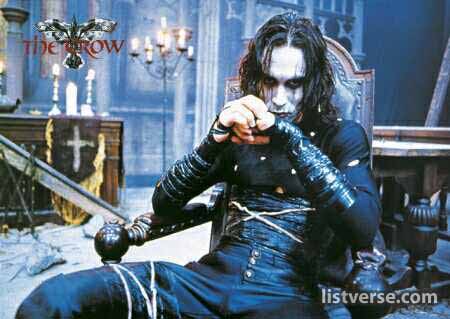
The Crow


I bought The Crow on DVD specifically for this project, mainly so I could write about my strange relationship with this film through the years.

The Crow is an adolescent revenge fantasy, which is exactly the kind of film that will win over a disaffected 20-year-old, which is more or less what I was when I saw The Crow for the first time in 1994ish.

To understand the impact of The Crow on our nation's youth circa 1994, consider for a moment how many people between the ages of, say, 18 and 25 cite The Boondock Saints as not only their favorite film, but the best movie ever made.

The Crow is like that, but five years older and with a better soundtrack.

Other than the late Brandon Lee, The Crow starred mostly lesser-known character actors, including the black Ghostbuster and Rochelle Davis, who played the young girl, Sarah, and who has not appeared in a film since. (Davis has appeared at cult movie conventions and has her own Myspace page, which looks pretty much like anybody's Myspace page gone to hell with all sorts of animated bits, bells, and whistles. Visit the page at your own risk — it'll probably crash your browser.)

The Crow was my favorite film once. Brandon Lee died on set, during filming, on March 31, 1993, from an accident with a prop gun. His fate did more for this film than any amount of marketing or clever "Alternative Nation" soundtracking.

People my age were drawn to The Crow because of the Brandon Lee tragedy, but I wonder how much Kurt Cobain's suicide also contributed to the morbid curiosity of the fanbase. Cobain killed himself on April 5, 1994, almost a year to the day after Lee's accident, and only a few weeks before The Crow premiered in theaters on May 13, when Brandon Lee visited us from beyond the grave.

I found myself looking at the officer's report from Kurt Cobain's suicide just the other day. I'm not sure what led me to that. More morbid curiosity, perhaps, or maybe just that Hole released a new album and — you know, I'm not even sure why I care about any of this shit anymore, but I do.

I'm the only person I know who ever went through a "Brandon Lee phase," during which I watched every Lee film I could find, which ended up just being Showdown in Little Tokyo and Rapid Fire. They were the only two films I could find at the Muncie Public Library and, somewhat coincidentally, the most I could tolerate because both films are total pieces of shit.

In 1994, The Crow was bleeding edge for digital effects work. That Alex Proyas was able to finish The Crow after Brandon Lee's death is astounding, and even now, I find myself struggling to tell the difference between the body doubles and Lee. Proyas' smoke and mirrors tricks still hold up. Slick editing, lighting, and visual effects saved this film.

Visually, this film is still remarkable, even though some of the digital effects are showing their age (though no more than any other film from this era, and less so than films from before). I can forgive a lot with The Crow.

However, the acting is piss-poor. Brandon Lee's stilted line readings and the antics of T-Bird, Tin-Tin, Skank, and Fun Boy are all horrible. How come this didn't bother me before?

Who thought the Thackeray line "Mother is the name for God in the lips and hearts of all children" was anything less than pretentious ass-hattery? Probably the same person who thought quoting John Milton wasn't a bad move either.

I re-watched this film in 2005ish and found myself laughing at the acting. I ridiculed the quote "Fire it up! Fire it up!" because, well, it's stupid. The clothing, the hair, the music — basically I re-watched this film with just enough distance from the '90s to realize, wow, what a pretentious bunch of assholes we were then, in our layered post-industrial clothing and black boots.

(Even tonight, my wife couldn't watch. "There's some really bad acting in this film!" she said, not long before she just gave up and went to bed.)

And yet, I can't dislike this film. I understand why I liked the film in 1995, and I understand why I didn't in 2005, and that lets me enjoy this one all over again in 2010. This film affected me, and millions like me, 15 years ago. Now that I have even more distance, I can re-appreciate The Crow not just as a morbid curio, but as an important film not just to me, but to '90s youth culture. Revisiting that is fun now.

One can't contemplate The Crow without making note of the classic soundtrack, with songs from The Cure, Helmet, Stone Temple Pilots, Rollins Band, Nine Inch Nails, Rage Against the Machine, and several others. This soundtrack was pretty much was the most amazing thing ever when I was 20. I still consider the Brandon Lee rooftop run to Nine Inch Nails' cover of Joy Division's "Dead Souls" one of the most badass sequences of the 1990s.

One last thing: I still have this poster, which hung in my college apartment for years, creeping out every woman I who ever came over (which really wasn't that many).

The poster came with a cardboard backing, so I never unwrapped the thing. I just put it on top of stuff or taped the whole thing to a wall. After college, I moved out of that apartment and back home, where I put the poster — cardboard backing and all — in a closet. There the poster stayed for almost 10 years, until I finally decided to get the very last of my belongings out of Dad's house. Now the poster sits in a closet at my house, and probably won't hang anywhere anytime soon. (See previous remark about creeping out women.) The poster is still wrapped in its original plastic.

What can I say? I hang on to things.

Wednesday, May 5, 2010

Crash


Crash divides people — maybe more than any other film of my generation.

Detractors call the film undeserving of praise, overrated, manipulative, pretentious, unrealistic, ham-handed, oversimplified, blah blah blah.

Mostly, though, people reject Crash because even though Brokeback Mountain is probably a better film, Crash somehow won the Academy Award for Best Picture in 2005 instead. They assume some conspiracy exists among homophobic Academy voters. Some just flat deny that Crash won, calling Brokeback Mountain "the real Best Picture of 2005." People are still complaining.

This isn't the first controversial win for Best Picture. How Green Was My Valley beat Citizen Kane in 1941, but look at the AFI Top 100. There's Citizen Kane, safely at #1, and How Green Was My Valley didn't even make the list. The Greatest Show On Earth beat High Noon and The Quiet Man in 1952. Only High Noon made the AFI list. In 1976, Rocky won Best Picture, beating Network, All the President's Men, Bound for Glory, and Taxi Driver.

No one talks about those upsets like they talk about Crash vs. Brokeback Mountain. Tragically, these two completely different films are forever linked, so people can't help but compare and argue. Look at the one-star reviews for Crash on Amazon.com. That's just one site.

My theory? Crash won because the film is set in Los Angeles and holds a funhouse mirror up to race relations in urban society, and Academy voters identify with that more than with latent homosexual sheep herders. (No one ever said this had to be complicated, and I'm not saying they're correct. I'm just theorizing here.)

I view Crash differently than most people, many of whom think the dialogue is forced, and that no one talks to each other in this way. I lived in Chicago for a time. I've visited Los Angeles, San Francisco, Detroit, Cincinnati, and Atlanta, to name a few. Oh yes, people do talk to each other this way — maybe not as overtly, but yes, conversations like these happen every day.

America is an angry place, and people point fingers when they're angry, and sometimes total strangers just deal on each other when they don't get what they want for the umpteenth time.

I also view this film as a kind of "what if?" scenario. What if, for one day, racists said what they thought directly to the targets of their feelings? What if, for one day, even people who considered themselves "open-minded" were forced to confront their own latent racist tendencies?

But even that oversimplifies Crash. Can you conquer racism in one day, or can you just "do a little better each time," as Cleveland Brown says on "Family Guy"? Is progress glacial, tectonic, something else? What is the true nature of progress? Where are we now, and where are we going?

Whereas Brokeback Mountain broke my heart, Crash provoked an equally visceral reaction in me. I went from shocked to angry to horrified to panicked to overjoyed and back again. Detractors say they felt manipulated. All filmmaking is manipulation. All storytelling is manipulation. The trick is hiding the manipulation so the audience isn't taken out of the story.

That's where Crash slips. Watching again, I felt many a twinge, especially toward the end, and I felt a little cheap. Maybe I'm viewing this differently now because I've seen a blue million films in which every character arc intersects in some clever way, and I'm tired of that. But let's not forget that Crash was not the first nor the last film to weave character arcs.

Where Brokeback Mountain told a love story and examined homophobia and intolerance in rural America in the latter half of the 20th century, Crash examined modern-day race relations in urban America. Crash is not a failure, but simply struggles to do too much and ends up not doing enough. But damn if the filmmakers don't try.

Perhaps Crash fell short, not necessarily due to pretension or ham-handedness, but by focusing exclusively on race. Had the film expanded the theme of intolerance to include gender and sexuality, the film may have been much stronger. Racism does not exist in a vacuum; other "isms" inhabit the same world, often in the same people. Of course, then the film would've been three hours long, but that's not a bad thing.

To dismiss Crash outright, or to say the film provokes no discussion or has no worth is wrongheaded. Unfortunately, Crash is not a perfect film and history likely will not be generous. Brokeback Mountain fans will continue to rage, and film snobs will scoff at the mere mention of Crash.

Let them all talk.

I saw Crash in a theater. All around me were African-Americans, Hispanics, Asians, and other Caucasians. My girlfriend at the time cried no fewer than four times, starting with the first scene between Thandie Newton and Matt Dillon. Jeers, shouts, and hisses went up at various racial remarks in the film. The audience felt divided.

But all of us were screaming when the little girl ran out the door. All of us.

Monday, May 3, 2010

Cop Land


I saw Cop Land in the theater sometime in 1997, most likely on a date, or possibly with roommates. I remember seeing the trailer and thinking, holy shit, who isn't in this film? And who's the director? James Mangold? Who? Didn't matter. I had to see this movie.

This was only James Mangold's second film. This guy has some chops as a writer-director. He was 34 years old when he made Cop Land. I'm 35 now. I try not to think along these lines. Keep moving forward, keep my head up, keep writing, do what I can, and don't look backward.

For some reason, maybe my own naivete, I still have this belief that if you write a solid story, great things can happen, and in my head, Cop Land is an example. (Of course, when Miramax is behind you, and if the year is 1997, all kinds of stuff can happen and all kinds of people will show up to play roles. It was the '90s. Free indie film love, baby. Or something.)

Let me throw some names at you: Sylvester Stallone, Robert De Niro, Harvey Keitel, Ray Liotta, Robert Patrick, Michael Rapaport, Janeane Garofolo, Annabella Sciorra, John Spencer, Peter Berg, Debbie Harry, and Method Man are all in this film. If that's not enough to get you interested, then I'm not sure why you're still reading. You like movies, right?

Robert De Niro brings back his Rupert Pupkin look for this film. He plays a great Internal Affairs guy, and seeing De Niro in scenes with Sylvester Stallone is a real thrill, second only to De Niro and Al Pacino together in Michael Mann's Heat. De Niro owns the role, even though this isn't exactly a reach for him, and seeing him here makes me wonder why he hasn't gotten better roles recently. Answer: The stories aren't there. Films like Heat and Cop Land don't come along nearly as often as, say, Meet the Fockers.

Stallone plays a schlub sheriff in a Jersey town full of New York cops, many of whom are crooked but found a loophole that allows them to live across the water. Stallone's character turns a blind eye to their dealings. He's a pushover. He's deaf in one ear because he saved a girl from drowning in a car accident. He can't be a "real cop." He can't be with the girl, either, because she's with some abusive douchebag. So he does what he can as a sheriff, and he looks out for her, sort of, and he goes home alone to listen to Springsteen's The River album.

People forget Stallone can actually act. People forget that Rocky won Best Picture, and Rocky Balboa put a great button on a Rocky series that really needed a button. Stallone spent the bigger part of the last 25 years doing bad sequels to good films, hyperviolent, Reaganized drek, and unfunny comedies confined to the D-movie dustbin. But put him in a role he can own and he shines. This is the best work Stallone has done since the first Rocky film. His scenes with Annabella Sciorra are just heartbreaking.

"You know, you can get this on CD...in stereo," she tells him as they listen to "Stolen Car" off The River. She's forgotten about his ear for a moment.

"It wouldn't matter to me," he says, and something tells me he's not talking about his ear anymore. He's talking about holding on to the past, the music he played around the same time as the accident, and how Springsteen lets him live a life he never got...a kind of parallel thing in his head.

"Oh, right," she says, just as Springsteen's lyric, "We got married, and swore we'd never part." Of course, Freddie and Liz never did either of those things, but something in the song says they should've, and maybe they did in another life, if you believe that sort of thing.

"Why is it you never got married, Freddie?" she asks.

"All the best girls were taken."

With writing like that, I totally see how this film got made. Fair play to James Mangold. I re-watch Cop Land about once a year, and if I catch this film on television, I can't change the channel. Cop Land is one of those films.

There's nothing particularly earth-shattering about the storyline. In fact, the ending is pretty ham-handed, with the news reports that just scream "Oh, shit, we forgot to tie up some loose ends. Let's have voice-overs from broadcast journalists fill in the holes as the credits roll!"

But that's a small complaint, and as that comes at the very end, I can't complain. Otherwise, this is good storytelling with an original approach, and seeing all these great actors, all these guys who have made a living playing heroes, villains, and the grey between, all together in the same film, well, that's why I watch movies.

Sunday, May 2, 2010

The Conversation


I tend to forget The Conversation. That doesn't mean I think the film is bad. I forget lots of things.

Actually, this DVD is a recent pickup for me. While browsing in Half Price Books a month or so ago, I saw a copy and decided to include this film in the project. I haven't seen this in years — probably not since film school.

Re-buying and re-watching films is a necessity for me. I forget things. I forget lines of dialogue, pivotal scenes, frightening moments, and entire plots. I'd forgotten just about everything about The Conversation. That's not right.

I'd forgotten about Harry Caul's paranoia, his distrust of everyone, and his loneliness. He has no friends, no lovers, and doesn't even get involved with his clients' affairs. He just records conversations. He keeps this cool distance from everyone. I'd forgotten about Coppola's masterful direction and Gene Hackman's brilliant portrayal.

I'd forgotten about the long and meandering post-convention party in Caul's loft, during which he has a side conversation with a woman and actually opens up, really makes himself vulnerable, and finds out a few minutes later that one of his surveillance buddies, also at the party, had him bugged the whole time. He rages as the intimate conversation is played back for everyone to laugh at — look at Harry Caul, so vulnerable. No wonder he has trust issues.

I'd mostly forgotten the entire plot — something about a conversation Harry recorded, and how that opened doors and sucked him into a world of shady dealing and murder or something.

I'd forgotten about the masterful, jarring editing, and the sound editing, unlike anything I've heard in any other film, splicing bits of the conversation throughout the film.

I'd forgotten about the twist at the end, and the reveal as Caul figures out what happened in room 773. (Ang Lee uses a similar editing technique to show how Ennis Del Mar figures out what happened to Jack Twist in Brokeback Mountain.)

I'd forgotten about the toilet. How? No idea.

Oh, yeah. Gene Hackman more or less reprises his role in Tony Scott's Enemy of the State, although in the latter, his character goes under a different name. Whether that is Caul's choice to remain anonymous or Scott's choice to keep from getting sued, I'm not sure.

Some say Scott's film is a sequel in spirit only, and Hackman's character is just an echo of Caul. I tend to agree. I like that Scott put the references to The Conversation in his own film, and just left them there for people to catch or not catch. Let the audience be smart or not notice. The movie works either way.

However, Enemy of the State is not nearly the film as The Conversation. Coppola uses these long, quiet takes to build tension and dread, and with the entire film told from Harry Caul's perspective, we're limited to what he knows and what he figures out. Scott likes to cut every .03 seconds and he loves him some flash editing. The two films are completely different in tone, style, and substance.

Lastly, I forgot that the most important scene of this film — the actual conversation — takes place in Union Square in San Francisco. Tonight the wife and I put on The Conversation, and within minutes she said, "We've been there."

We spent part of our honeymoon at the Grand Hyatt, which is right there. Admittedly, I had to look at a map to put all of this together. Conveniently, there is a map drawn on a blackboard at about the one-hour mark in the film. So imagine my wife, standing in front of the television, using the map from the film as a reference to show me where we were in San Francisco. "There's the Grand Hyatt, there's Rasputin, and if you go that way, you get to Chinatown..."

I can't remember anything. We were out shopping today and I suggested I get some gingko. Clearer, younger, more female minds prevailed. I'll probably buy some when she's not looking. That is assuming I remember.