Tuesday, July 27, 2010
Eagle vs. Shark
"My mom got kicked in the head by a cow. I can't go near cows now because I think about her too much."
Such is the kind of dialogue you get in Eagle vs. Shark. Here's a choice exchange between brother and sister:
"Stop calling me 'cockhole,' bitch."
"Cockhole."
"Grr! You're a bitch, and you're gonna die of diabetes."
I mean, come on.
Eagle vs. Shark is a terribly underrated and unknown quirkfest of an independent film from New Zealand, directed by Taika Waititi. The protagonist, Lily, is a fast food clerk who has a crush on Jarrod, a video game store clerk (Jemaine Clement from "Flight of the Conchords"). In short, they get together, and Jarrod invites Lily to visit his hometown, so that he can fight his high school nemesis, Eric. When they arrive, Lily meets Jarrod's family. Quirkiness with real emotional depth ensues. You even get whimsical stop-motion animated interludes featuring apples.
As much as I hate the comparison, this is sort of like Napoleon Dynamite, but more heartfelt, and more New Zealand-y. I really don't want to reveal many more specifics about the story of Eagle vs. Shark. You're either in the camp who can take a quirky indie film or you're not.
But I will say that Jarrod wears pants that say "Awesome" down the leg. He also has a mullet. If that does anything for you, like if you want to rent a movie and find yourself in a mood to watch a man with a mullet wearing pants that say "Awesome" down the leg, then I would suggest Eagle vs. Shark.
Unfortunately, films like Eagle vs. Shark, Napoleon Dynamite, and to some degree, Juno, all get lumped together under the umbrella of precious and condescending (and sociopathic, misanthropic, and downright eeeevil) indie comedies, a categorization that I reject. Those critics miss the point.
Here's a screed on Napoleon Dynamite and Eagle vs. Shark, written by someone who openly admits to not watching all of the latter. Obviously he wasn't engaged with the subject matter, which is fine, but he makes some pretty damning accusations about a film he didn't finish.
Eagle vs. Shark is sort of like a Todd Solondz film, but infused with actual joy and humor, and doesn't leave me feeling empty and hopeless, like my heart has been squeezed and my confidence in the goodness of humanity has fallen away. If you want to understand why we have school shootings and why little girls and boys grow up to be horrible people who tell homeless people to get jobs and think Sarah Palin is just neat, then watch a Todd Solondz film. I'm not saying his work is bad, but you'll want antidepressants afterward.
Eagle vs. Shark does the opposite. Despite taking me to dark places and offering awkward, hide-behind-the-couch humor (my wife's phrase), the film ends on a note so uplifting, I really don't want to hear the cynics bitch. (Also, any movie that features The Stone Roses' "This Is The One" under the climactic sequence sells me right there.)
It's not that films like Napoleon Dynamite and Eagle vs. Shark have no heart, or that the directors hate their characters, but you'll hear plenty of critics say that. It's that these characters have so much heart that the directors have trouble getting all of it on the screen. (I know that sounds sentimental, and I don't care.) Waititi's characters harbor deep longing, unfulfilled dreams, and repressed emotional traumas, and they keep going despite their pain, and fuck if they don't find joy in their lives anyway, with quirks as their defense mechanisms against the world and all the bullshit that life has dealt them. These are characters who get up, every day, no matter how much it hurts, and they do stupid, insane things to themselves and other people, and they instantly regret what they've done, and they stumble onward.
To dismiss this film is to not understand; these characters are not empty — they're too full, and what spills over is what they can't contain. There is something rare and beautiful here, and because I identify with these kinds of characters, I find myself laughing not at them, but at the pieces of myself that I see in them.
Monday, July 26, 2010
Drunken Angel
Drunken Angel is Akira Kurosawa's first film with longtime collaborator Toshiro Mifune, the legendary Japanese actor who appeared in 16 of Kurosawa's films between 1948 and 1965, along with another 160-plus films in his long career.
Here, Mifune plays a gangster who has taken over some territory in postwar Tokyo while the real boss, Okada, is away in prison. Mifune's character is all bravado; he suffers from tuberculosis, one of myriad diseases to strike postwar Japan. Kurosawa's tackling the issues of the time is a brave move that elevates this picture from your standard noir exercise to film art, and for these reasons, the film is widely considered Kurosawa's breakthrough piece.
But Mifune is not alone here; his opposite number is a bristly doctor played by Takashi Shimura, who Kurosawa cast in more than 20 films from 1943 to 1980 (yes, I'm looking at the same Wikipedia entry as you; I'm not writing a master's thesis here). Although the Kurosawa-Mifune collaboration is a bit more widely known, Kurosawa's collaboration with Shimura started earlier and ended later, resulting in more finished films and a much richer legacy.
All trivia aside, what really works for me in Drunken Angel is the writing — at once embedded in the context of postwar Tokyo and presenting characters still relevant in the present day. Kurosawa and co-writer Keinosuke Uekusa based Mifune's character loosely on a gangster Uekusa knew personally, but the two writers struggled with Shimura's character, fighting to keep the doctor interesting and fully formed rather than a wooden do-gooder whose altruism would bore audiences and ring false. Only when Uekusa and Kurosawa remembered an alcoholic doctor they both knew in Yokohama did they find the inspiration for Shimura's character here. They needed a character with flaws rather than someone who exuded plain goodness.
That kind of character development and contrast is essential for storytellers. Yet every day, hundreds of scripts float around Hollywood with exactly this problem.
Kurosawa's films always seem informed by his life experiences, but not so much that his stories were overwhelmed. Here, he clearly bases his two leads on real people from his life, and in doing so creates two of his strongest characters, possibly the strongest characters he'd created at this point in his career.
I often feel uncreative when I base characters and/or events in my scripts and short stories on real people and experiences. Anybody can write down something that actually happened, right? The real writer is the one who can create from nothingness, right? I then have to remind myself that there is no such thing as "writing from nothingness."
Writing doesn't happen in a vacuum. We write from somewhere; good writers just have the strength of articulation. We don't choose the events, but we do choose the words. Throughout Kurosawa's career, he used real people and experiences as fodder for his work; there's nothing wrong with this. Sometimes these things are truer. But we can't forget the drama and the structure, too.
At about the 45-minute mark, Kurosawa turns to the guitar player who has been plunking away at the same song in the streets at night. Out of the shadows steps an older man who asks to see the guitar. He takes a seat and plays a more complicated tune (well, he mimes playing — the sync is off and so are the placements of his fingers). This is Okada, the boss that Mifune's character has replaced. Just as Mifune's and Shimura's characters have buried the hatchet, a bigger fish arrives (unbeknownst to them) to raise the stakes. That's good writing.
Drunken Angel tackles some issues that you just didn't hear much about in postwar American film. Although the Japanese couldn't depict the occupying military force at the time (along with several other prickly censorship regulations), in America, you'd be hard-pressed to find a mainstream film from the same time period that openly discusses syphilis and uses profanity. Drunken Angel does that, and along with depicting characters closely resembling people, places, and a time the writers knew, seems all the more real for doing so.
Sunday, July 25, 2010
Akira Kurosawa's Dreams
I'm usually not interested in other people's dreams. The conversation usually starts like this: "I had the strangest dream." Then the person insists on telling me a story made mostly of nonsense, and when the story (mercifully) ends, the conversation usually ends like this: "Isn't that weird?" That is sometimes followed with: "What do you think that means?" Example:
"I had the strangest dream. I was in the grocery store, and they didn't have any milk, so I asked if they had some in the back and they invited me to the back room to check with them. I went along and found gallons and gallons of milk, but they were all sitting outside the cooler, and a giant spider was guarding them. I said, 'What about this milk?' and the clerks all laughed at me. Then the spider started chasing me, but it wasn't a spider anymore; it was a crab. I ran for a while until one of the clerks hollered at me to start running sideways and the crab couldn't get me. But then the crab got me and when I turned, the crab was my second grade teacher, and then I woke up. Isn't that weird? What do you think that means?"
Uh, yeah, that's pretty weird, but also frustrating to hear. I'm used to stories with your typical beginning-middle-end structure, so when I hear a story with a beginning of sorts and a middle or something like a middle, and an ending that is always the same ("Then I woke up.") my instincts as an interpreter of stories is to try and organize the information. I get frustrated easily when stories don't make any sense, when details are introduced with no payoff or clear direction, and when suddenly, the elements of story that we typically consider anchor points — identities of characters, locations of stories, objects for the dreamer to accomplish — can change without warning or logic. This is the nature of dreams, not the nature of storytelling.
In short, when a person recounts a dream to me, that person is annoying me.
This is through no fault of his/her own. I just want to hear a story that makes sense, and I can't expect a dream to do that, nor can I expect the rest of the world to dream in effective three-act story structure. But in a way, I do expect that. I'm not saying I'm right; I'm just saying. I can't tell you everything. All I know is that I hate hearing people talk about their dreams.
So when presented with Akira Kurosawa's Dreams, I run the risk of extreme frustration and fatigue. Here's a two-hour film in which Kurosawa essentially makes film adaptations of his own dreams, with the exception of one vignette, "The Tunnel," which Ishiro Honda directs here. Dreams is a series of eight vignettes, each with a male protagonist, presumably Kurosawa himself. In each vignette, the protagonist is at a different age and experiences different realms — a forest in summer, a spring full of cherry blossoms, a windswept, snowy mountainside, and so on. The adventures starkly contrast with each other.
Oddly, I don't find myself frustrated at all. Perhaps this is a question of timing. I tend to watch slower films on Sunday afternoons, when the rest of the world is slow, too (in my head). Kurosawa was such a visionary, he dreamt in stories. Each dream, despite fantastic elements, spins coherent stories anyway.
Like "Crows," the one about the painter who, when wandering the Van Gogh museum, steps into a painting and finds himself talking to Van Gogh, played by Martin Scorsese. This Van Gogh is a brusque New Yorker Dutch painter. They talk about drive, cutting off an ear, and how little time there is left to paint. Then Van Gogh is gone, leaving the aspiring painter to wander Van Gogh's paintings in a search for the master. He eventually finds Van Gogh, walking in the distance, and then the dream is over. The painter never catches up to him. Pretty silly sounding, but highly effective on screen.
Dreams is an enigma is Kurosawa's body of work, but at this late stage of his career, he obviously felt free to do what he wanted, and here he uses his dreams to ruminate on themes such as the futility of war, mankind's potential to destroy the world, and the pursuit of art in a world in which the artist has little or no control. I'm combining his themes a bit here, but that's what I take away from this film. His latter-day works are often derided, but even Kurosawa's weak films are still better than most films released around the same time.
I teach a class in which I give an assignment that requires students to choose from my school library's holdings on DVD and write about them. Dreams is the only Kurosawa film we have at present, but this is a perfect film for a visual arts school. Naturally, I'd love if the library had all of Kurosawa's films, as well as another 1,000 DVDs, but I'm content with what we have for now, and with building my own library at home and keeping Kurosawa's entire oeuvre on hand for my own use. In August, Criterion will release Kurosawa's first four films in an Eclipse set. I'm all over that.
Kurosawa turned 80 the year this film was released. He lived another 8 years and made two more films, wrote a few more, and a final film, a documentary on Noh theatre, is rumored to be released in 2010. Kurosawa would be 100 years old this year, and organizations around the world are holding screenings and celebrating his life and work. Even his minor films are great.
Bram Stoker's Dracula
[Note: In the commentary for Bram Stoker's Dracula, Francis Ford Coppola says when he adapts a work, he typically puts the name of the original author in the title, a la Mario Puzo's The Godfather. Among fans, these works are customarily referred to by their original titles, sans author. By that rationale, Bram Stoker's Dracula goes under "D" here.]
I've always liked Coppola's version of Dracula, despite his style-over-substance approach and screenwriter James V. Hart's tweaking of the original story and rather anticlimactic ending (after the sun sets, Dracula explodes out of the crate that carries him, and then somebody just runs up and stabs him, taking all the fight out, and he lives a little while longer flopping around in agony...meh). While I've enjoyed this film several times over the years, I've never considered Coppola's version a "definitive" adaptation of Stoker's novel. Instead, this is just another interpretation — one that explores Dracula as a tragic figure rather than just a plain old bloodsucker.
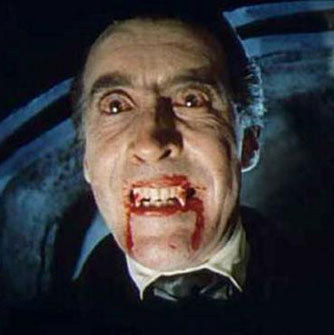
Of all the actors who have played Count Dracula over the years — Max Schreck, Bela Lugosi, Christopher Lee, Jack Palance, Frank Langella, Klaus Kinski, etc. — Gary Oldman is among the more memorable, but I think that's a generational thing. I wonder how this film will last. I've never heard anyone say Oldman is his/her favorite Dracula. He's not mine, by any means. The Dracula that I know and love is Christopher Lee.
Lee was Dracula several times in the Hammer Studios interpretations, which appeared on late night television when I was young. I'd stay up late with Dad and catch Sammy Terry, Indiana's late night horror movie host, and if we were lucky, we'd catch Christopher Lee. Thanks to Sammy Terry's show and my dad's negligence/coolness, I saw dozens of horror movies while growing up, including many of those Hammer films. I was probably too young, because in those days I braved my way through dozens of nightmares, and to this day I'm not all that comfortable typing at a computer in a quiet house in the middle of the night. I'm a bit jumpy.
(In the interest of full disclosure, my efforts to watch horror films did not always pay off. I also caught Invasion of the Bee Girls and Empire of the Ants while staying up late. I can remember Dad getting up in the middle of dozens of movies and leaving me with the remote control to soldier through such cinema shitpiles as The Swarm. Hey, they can't all be winners.)
So when I think of Dracula, I think of Christopher Lee rather than Gary Oldman, but I can't forget Oldman's portrayal. Then again, that might be because I can't watch this film without thinking of C. Montgomery Burns:
I couldn't help but borrow that image from this article, which is a dynamite read, by the way.
I once saw David Letterman interview Gary Oldman on "The Late Show." Oldman was detached, uninterested, and barely answered Letterman's questions. The interview was an awkward failure. I forget the film Oldman was promoting (maybe this one?), but I've never seen Gary Oldman in the same light. So when I see Oldman in this, or The Fifth Element, Leon: The Professional, Batman Begins, or any of the myriad films one can list, I can't help but remember that interview. He's a solid actor who disappears into his roles and often is quite frightening as a villain. I get the feeling there's not much inside him, though, sort of like how Peter Sellers has been characterized as a kind of shell for characters to inhabit rather than a self-actualized person who portrays others. Then again, maybe Oldman is one of those actors who doesn't have time for the Hollywood hype machine, and would rather be working than doing some late night promotional interview.
Anthony Hopkins as Van Helsing is an inspired choice. I love how he speaks so off-handedly about how he needs to cut off Lucy's head and then cut out her heart. Even Coppola seems in on the joke, and they come back to that a couple of times. Cary Elwes' horrified face is priceless. Did I mention Winona Ryder is in this film? I admire her work.
For most of the film, the 5.1 mix seems pretty ho-hum. However, at 1:27, right as Lucy vomits blood on Van Helsing, a kind of unearthly clatter swings from the front channels to the right rear channel, and even though I don't consider this film all that scary, that moment freaks my shit out (technical term), especially when I'm trying to type, the house is mostly dark, and I'm not exactly paying attention to that part of the film.
What's with all the voice-overs? Dracula, Van Helsing, Mina Harker, and Jonathan Harker all provide first-person narration at some point or another, either reading a letter to the audience or speaking journal entries. Everyone kept a journal in the late 1800s, apparently.
And what's with the match-cuts? I love a good match-cut as much as the next guy, but this film seems to have one in every scene.
Vampires are written to undeath, yet audiences keep going back. For me, Coppola's film isn't exactly a masterpiece, but works as one great director's interpretation in a world where everyone else seems to have one.
Friday, July 23, 2010
Donnie Darko: The Director's Cut
Richard Kelly's director's cut of Donnie Darko attempts to explain more about what this movie means, but tonight I caught myself wondering...is that necessary?
I sort of understood the first time. I liked that Kelly's theatrical cut left enough unsaid and allowed the audience to fill in gaps and interpret what we want. I typically like when writers and directors do that. I don't need all the answers.
Then again, I've never seen the director's cut before tonight, despite owning a copy of both versions on DVD for more than a year. Looking at the IMDB guide to the changes between the theatrical and director's cuts, we mostly get extended scenes and minor cuts that add up to quite a different film altogether.
Regardless of version, there's really no reason (on paper, anyway) for this film to work. Consider this futile and feeble attempt at a logline: A troubled teenager is awakened in the middle of the night, and he walks out of the house (grabbing a felt-tipped marker on the way?). Once outside, he is met by a demonic rabbit who tells the teen that in 28 days, 6 hours, 42 minutes, 12 seconds, the world ends. Uh...what?
Still, I love the sequence when Donnie arrives at school. His feet hit the pavement as he jumps out the back exit of the bus, we get a nice lens flare, and Tears for Fears' "Head Over Heels" leads us to this great, long take, introducing characters in the hall: the bully, the uptight but clueless teacher, the love interest, the bully again. (I love this song. Not the only Tears for Fears song in the film, either: "Mad World" is covered under the closing montage, and one easily can draw connections between the themes of Jim Cunningham's hack self-help videos and the name of that band, as well as several of their songs not featured in the film, but all over the airwaves in the '80s: "Sowing the Seeds of Love," "Shout," "Everybody Wants To Rule the World," and so on. I love this cast, too. God, I forgot Patrick Swayze was in this, and I forgot he was dead. Noah Wyle and Drew Barrymore: The man my wife would ditch me for in a second, and the woman with whom I'd return the favor. I digress. Let's get to the meaty contemplation here.)
Consider the theme of the Graham Greene short story, "The Destructors," which is discussed in Donnie's English class. Donnie theorizes that the reason why the children burn the money is that "destruction is a form of creation, so the fact that they burn the money is ironic. They just want to see what happens when they tear the world apart. They want to change things." Later, Donnie confesses to Gretchen that he was once in jail for burning down an abandoned house.
Compare that to this exchange between Bruce Wayne and Alfred Pennyworth when discussing The Joker in The Dark Knight:
Alfred: A long time ago, I was in Burma, my friends and I were working for the local government. They were trying to buy the loyalty of tribal leaders by bribing them with precious stones. But their caravans were being raided in a forest north of Rangoon by a bandit. So we went looking for the stones. But in six months, we never found anyone who traded with him. One day I saw a child playing with a ruby the size of a tangerine. The bandit had been throwing them away.
Bruce Wayne: Then why steal them?
Alfred: Because he thought it was good sport. Because some men aren't looking for anything logical, like money. They can't be bought, bullied, reasoned or negotiated with. Some men just want to watch the world burn.
Then, if you want, compare The Joker's handwriting to that of Donnie's graffiti painted on the sidewalk under the bronze dog. (Oh, come on. The school compares everybody else's handwriting to the graffiti. I'm just taking another step.) Not a perfect match, and I'm sure readers with more experience with typography can see glaring differences, but consider the scrawling, unaware of boundaries or lines, and how that might convey a loss of balance or structure in the writer.
The supposed nihilism continues. Donnie calls self-help guru and closeted pederast Jim Cunningham "The Antichrist" to his face in front of the school. Eventually, Frank the demonic rabbit tells Donnie to "burn it to the ground," so Donnie destroys Cunningham's house by fire.
Does Donnie's nihilism come from "just being a teenager" or from his association with Frank the rabbit? Well, now, let's not forget that his parents aren't exactly shining examples of caring. He comes from a conservative household more concerned with indoctrinating their children than teaching them about right and wrong. His father stifles laughter when he hears what Donnie said to his gym teacher, and his mom is repeatedly confronted with questions of her fitness as a mother. Donnie's father advises him to use the f-bomb on people. Donnie's gym teacher questions his mother's "commitment to Sparkle Motion."
About what, exactly, do Donnie's parents care?
Hollywood seems to associate nihilism with madness, when really, what is seen as nihilism might be an arrested state of existential crisis instead, or just the influence of bad parenting. While lamenting the existence of Smurfs while shooting bottles and drinking with friends, Donnie ponders the point of living. Is this nihilism after all? "The search for God is absurd if everyone dies alone," he says at one point in the film.
Donnie tells his English teacher about Frank, a 6-foot-tall bunny rabbit, which makes his classmates giggle. Let's not forget: This isn't the first time we've met a protagonist who can see a rabbit. In Harvey, the protagonist sees a mostly harmless rabbit. In Donnie Darko, the rabbit is the harbinger of the end of the world. Oh, and then, because rabbits don't play enough of a role, what is the Graham Greene book replaced with on the school curriculum? Watership Down — a book about a rabbit who can foresee the destruction of his warren and convinces his friends to get away from imminent danger.
[Forced Inclusion: I also have a pet rabbit, adopted from the Indiana House Rabbit Society (see link at right). Rabbits, rabbits everywhere, like in that episode of "Father Ted."]
Perhaps the great irony of Donnie Darko is that despite all the evidence to the contrary, Donnie really isn't a nihilist and he doesn't want to watch the world burn; in the end, he wants to put things right and save everyone except himself. He's a savior figure, not a madman. He brings balance by sacrificing himself. A nihilist wouldn't do that.
The tough part about this film is that there are so many interpretations. This is just one, given a smattering of references and what they mean. Maybe I'm hung up on this bizarre combination of trivia and semiotics. Maybe my interpretation doesn't hold water. Like a lot of stories set to film or written in books, upon revisitation I see a bit more, understand a bit more, question a bit more, and find the whole experience rewarding for different reasons each time. Also, just so we're clear, there's no way in hell I could ever write a film like this. Richard Kelly's stuff is beyond me. I don't walk away with the desire to write my own story. I just walk away with a tweaked perspective, and I enjoy that almost as much.
Ultimately, I'm glad both versions of Donnie Darko exist. They work as companion pieces; the original cut is the definitive, while the director's cut is a kind of "alternate universe" version, which makes total sense for a film set mostly on an alternate timeline.
Thursday, July 22, 2010
Dogma
Dogma is Kevin Smith's best film. I realize that now.
I didn't in 1999, when I saw the film in a theater in Muncie, Indiana, with some friends from college. We laughed at the platypus jokes in the opening disclaimer. We laughed at the dick and fart jokes throughout, and we felt cool because we recognized all the Kevin Smith players — folks he put in most of his early films such as Brian O'Halloran, Jeff Anderson, Jason Lee, Dwight Ewell, and Walt Flanagan. I was still a big fan of Clerks and Mallrats. I just wanted another small story about losers.
What I got was a big story about existence, redemption, fart jokes, and the fallibility not of God, but of organized religion. With a cast that includes everybody from Bud Cort to Alan Rickman, Dogma is equal parts Hollywood and indie, and is easily the best writing Kevin Smith has ever done.
At 24, I was relatively unfamiliar with Catholicism, and as such, I found the plot pretty convoluted. I kept up, but man, he had ideas flying around here. This is an ambitious project for a guy who was known for setting an entire movie in a convenience store.
Dogma isn't perfect, though. For instance, Linda Fiorentino is terrible in this film. Watch the scene between her and Alan Rickman in the Mexican restaurant. Every line of hers is delivered in this weak, sardonic tone, plus most of her lines are questions, and the shrugging, the shrugging, oh, the shrugging, and that damned eyebrow. She drives me nuts. Without Alan Rickman to save the scene, the film would lose me right there. If not for the writing and the rest of this ensemble, really, I wouldn't be able to get past her performance grating on me.
Of course, the dialogue is full of cardinal errors (no pun intended) such as too much Q & A, with the "A" being backstory and exposition for the religiously ignorant (redundant?), but I can forgive bad writing — I have a closet full of it. What I can't forgive is bad acting. Putting Linda Fiorentino across a table from Alan Rickman is sort of like chasing a 12-year-old single malt scotch with Coors Light. She's so out of her league here.
You know how Bartleby and Loki march around this film, clad in black coats and blue jeans? For a moment in the Mooby's corporate boardroom, they sort of seem like proto-Boondock Saints. Given the release date of Troy Duffy's Golgothan of a film, in January of 1999, vs. the release of Kevin Smith's, in November of that same year, one might wonder if there's a connection with the look of the saints and the angels. Or maybe they just had the idea at about the same time. It happens.
What I appreciate most about Kevin Smith is his reverence to his inspiration and influences. Bud Cort, the star of Harold & Maude (one of Smith's favorite films), is the human shell that houses God. (Read into that all you want.) Betty Aberlin, a regular player on "The Smothers Brothers Show" and "Mr. Rogers' Neighborhood," appears as a nun. Guinevere Turner, an actress and writer who inspired Smith's Chasing Amy, has a bit role as well.
Alas, even though Dogma is Smith's best film, this is also where he started to veer. The years between Dogma and Clerks II were more or less Kevin Smith's "walking in the desert years." I get the feeling, looking back at his earlier stuff, that he sort of ran out of ideas and got too caught up in the Hollywood machine after Dogma. His films became vehicles for inside jokes, and that's fine, but then he made an entire film out of that in Jay and Silent Bob Strike Back. Then he focused on his kid, and how his life changed, and he made Jersey Girl. He got it in his head that he had to make a film that showed his grown-upness. Why bother? Jersey Girl didn't work because the film didn't feel true to Smith's style. Everything about that film felt forced and sentimental.
Dogma is a personal film that works. Dogma represents much of what Kevin Smith believes about Catholicism and religion in general. What can be more personal than one's relationship with God? Everything after Dogma feels thin and untrue to Kevin Smith's style — Clerks II notwithstanding.
Smith could've made an entire franchise out of Jay and Silent Bob having adventures and saving the world. Instead, he retreated, and then did this meta-filmmaking thing (Jay and Silent Bob Strike Back) that was pretty self-indulgent, all things considered. Then his life changes made his work turn sentimental, and he embraced that direction (Jersey Girl). In doing so, he forgot about writing, research, compelling stories, and creating what you know.
I look at Dogma and I see an extremely well written film (Q&A forgiven) that he's been trying to follow up ever since. When he made Clerks II, I felt like he was turning a corner. Coming back to his roots was and still is the best thing for him. I still get a little teary-eyed when he goes to black and white at the end of Clerks II. I thought he'd come home. But then he started wandering the desert again.
For me, Kevin Smith films remind me of college and those big, irrational dreams and fantasies of succeeding as a writer. As a college student and aspiring screenwriter from Indiana, like many other awkward geekboys, I felt a connection to what Smith was doing. I saw his films and thought, "I want to do that," and he inspired me. He was like Hal Ashby for my generation. I typed — on a typewriter, mind you — my first screenplay with a copy of his scripts nearby for reference.
I miss the feeling I used to get when I saw a Kevin Smith film and walked out feeling charged up, inspired, encouraged, and ready to take on the world, to save my own. I miss that feeling and I worry that I'll never feel that way again, never get that inspiration or feel that energy. I come home from work too tired to think about this stuff. I barely have the energy to blog.
Mostly, I miss youthful dreaming, and even though I'm only 35, some days the light looks dimmer.
I miss the feeling I used to get when I saw a Kevin Smith film and walked out feeling charged up, inspired, encouraged, and ready to take on the world, to save my own. I miss that feeling and I worry that I'll never feel that way again, never get that inspiration or feel that energy. I come home from work too tired to think about this stuff. I barely have the energy to blog.
Mostly, I miss youthful dreaming, and even though I'm only 35, some days the light looks dimmer.
I read an article recently about a writer who was worried about his age. Hollywood loves young people, and as aspiring creative types approach 40, the door basically shuts. That is, unless you have a good story. Age doesn't matter if you have a good story.
If you can write and entertain people, you don't have to be young. Sometimes you have to be a little older to know how to do those things. No one requires you to put your date of birth on your writing. No one puts an expiration date on dreams. If I keep writing and pushing, then maybe. If I don't keep writing and pushing, then I have nobody else to blame.
Friday, July 16, 2010
Dodgeball
This might be the only sports movie I've ever seen that featured a pirate named Steve.
Dodgeball falls into the category of "stupid comedy" — the kind of film that takes nothing seriously, sticks closely to formula, and features characters that are barely two-dimensional, then laughs all the way to the bank.
Nothing about this film is particularly brilliant, until you start listening to the dialogue. During the Dodgeball instructional film, we get a couple of great lines about lead-based paint and how "Chinamen" in an opium den invented dodgeball by throwing human heads at each other. Hank Azaria randomly shows up as "Patches O'Houlihan," a star dodgeballer with a pencil-thin mustache who encourages ganging up on weak players.
Later, modern-day Patches shows up in the form of Rip Torn, who growls, "I love the smell of queef in the morning." I'm pretty sure I've never heard the word "queef" in a film before or since this one. So we have a pirate named Steve and an instance of the word "queef." This is not film school material.
Yet there's something brilliant going on here. The film doesn't care how offended you are; in fact, Dodgeball revels in the juvenile humor. We're not just talking about the easy "balls" humor throughout the film or the promotional campaign that was everywhere several years ago. We're talking about brilliant comic dialogue, with layers:
"Good toss by the submissive out there!"
"It's gotta be the hair: Feathered and lethal. You just don't see it nowadays."
"Ouchtown, population: You, bro!"
"We're gonna get out taints handed to us, that's what!"
"Well, they don't really make a 'Sorry your dodgeball coach just got crushed by two tons of irony' Hallmark card."
So, "queef," "taints," and a pirate named Steve. This is not a family-friendly film. This is a film you watch by yourself after the wife goes to bed. I know because that's what I just did tonight.
Plus, look at all these cameos! After the first dodgeball match, there's Curtis Armstrong, "Booger" from Revenge of the Nerds, playing a bit role and awarding Average Joe's their first trophy. Later, in the Las Vegas sequence, Chuck Norris shows up as a committee member/judge type. Jason Bateman and Gary Cole appear as commentators, and Bateman steals every scene, bro. David Hasselhoff shows up as... David Hasselhoff. William Shatner appears as The Dodgeball Chancellor. Let's not forget Lance Armstrong, who gives a motivational speech for the ages in one of the greatest sports cameos ever:
"Quit? You know, once I was thinking about quitting when I was diagnosed with brain, lung and testicular cancer, all at the same time. But with the love and support of my friends and family, I got back on the bike and I won the Tour de France five times in a row. But I'm sure you have a good reason to quit. So what are you dying from that's keeping you from the finals?"
Stupid comedy? Sure, but nobody ever expected Dodgeball to enter some pantheon of fine filmmaking. This is no Citizen Kane. This is a dumb movie about a fringe "sport" inspired by a children's playground game, and in a way makes fun of all the movies about sports, with the cliches and boilerplate plot intact. The weaknesses of Dodgeball are in many ways liberating for all involved. Forget the plot holes. This isn't high art. This is barely a movie. Let's make fun of pretty much every sports movie cliche ever.
Yes, most of the jokes are juvenile, the acting is flaccid, and the plot is ludicrous. The humor goes to racial and gender/sexuality stereotypes too often. There is nothing technically or aesthetically groundbreaking here, and as a human being, I probably am dumber for having watched this film not once, but several times over the years. Some movies just rot your brain.
But...
When I watch a film like this, two sides of me fight. One side, the academic, mature side, wants to take offense and bemoan the decline of western civilization if this is the kind of base tripe people enjoy these days. I want to get my hackles up when I hear some of the jokes, obviously written from a masculine perspective and hung up on humor untouched by modern feminist thought.
The other side of me, however, sees a definite purpose for comedies like this one, and sees a certain measure of genius at work here. Most comedies offend some people on some level. Let's not forget that the Marx Brothers frequently referred to "darkies" and made fun of fat people all the time. Dodgeball can't match the genius of a Marx Brothers movie (or the outright racism, and I'm glad), but Dodgeball has a certain smugness that equates masculinity with heterosexuality one minute, and the next seems to revel in the opportunity to stand on the blurry line between homoeroticism and athleticism. That kind of balancing act is interesting. The humor might be offensive, but smart people had their hands in this one.
Oh, and the name "White Goodman" kills me. Not only is the name on-the-nose in an ironic sort of way, but it's an obvious reference to the dark romanticism of Nathaniel Hawthorne's "Young Goodman Brown." Seriously.
Okay, not really.
A few years ago, I had a brainstorm. Nobody has done a movie about the most midwestern of midwestern games. Some call the game "beanbags." Others just call the game "bags." Most folks I know call the game "cornhole," and with not much irony.
When I saw Dodgeball, I went away thinking, "What other fringe sports haven't been turned into films?" Then cornhole hit me. Plus, imagine the obvious anus jokes! "This could be my ticket," I thought. I hadn't come up with an idea that original in a long while. I was almost proud of myself.
See, when I was first learning how to write screenplays, all I wanted to do was write simple comedies with quirky characters in even quirkier situations. I'd come of age watching Kevin Smith and Richard Linklater films and figured, hell, if those guys can do this, I can do this, right? So I set out to write stuff in that same direction, only to come up with derivative stuff no one wanted to read. I put those aside and started looking at dark comedies, but I wasn't equipped to write those. Then I turned to drama, only to find out I was shit at drama. Back to comedy I went. But I had no new ideas.
Then the cornhole idea came to me one day, as though in a vision. I pitched the idea to my wife (then girlfriend) and a couple of friends, none of whom thought the idea would be worth a damn. I never wrote the film. I'm not saying I could've written a good cornhole movie, but writing nothing, well, I'll never know. I shelved the idea. Not a good idea for a movie.
Oh, wait.
Monday, July 12, 2010
Dodes'ka-Den
Dodes'ka-Den is a minor Akira Kurosawa film, only in the context that the story here is not as strong as, say, Rashomon or Seven Samurai. Despite the narrative shortcomings, the film is significant in Kurosawa's oeuvre for several reasons.
On a technical note, this is Kurosawa's first foray into color filmmaking. As such, the color palette here is stunning. Vibrant reds and blues often pop from the screen while yellows and greens provide accents. This is Kurosawa painting with film for the first time, so the colors are exaggerated — no slum has this kind of paint job — but Kurosawa clearly loves this first real chance to make a color film. He even gets a shot of a rainbow in before the half-hour mark. You had to see that coming.
Also, Dodes'ka Den is Kurosawa's first film without Toshiro Mifune in more than 20 years. The great Japanese actor played lead roles in most Kurosawa films, starting with Drunken Angel and ending with Red Beard just prior to Dodes'ka-Den.
So what's with the title?
Pronounced "Doh-DES-ka-Den," the title refers to an onomatopoeia in Japanese referring to the sound a train makes. One of the characters, a mildly mentally disabled boy, fantasizes about driving a trolley. With every shot of him, we hear him chanting, "Dodes'ka-den, dodes'ka-den," and so on. Kurosawa makes an interesting choice by providing Foley sound for when the boy is miming the actions of a driver. We hear clicks and horns and so on, even if we see nothing. This puts us right in the mind of the boy (and provides a tempting bit of film to use as an example in the audio production class I teach — I love Foley sound).
Unfortunately, this film was a critical and commercial failure. That coming on the heels of Kurosawa's dismissal from the U.S.-Japan production of Tora! Tora! Tora! only contributed to Kurosawa's spiraling depression at the time, and between 1965 and 1975, Kurosawa only completed three films. The great Japanese director attempted suicide in 1971, not long after the failure of Dodes'ka-Den.
Thing is, this isn't a bad film (though probably the closest Kurosawa got to making a bad film in color). This is just a distinct departure for him. After excelling with films set in feudal and modern-day Japan, Kurosawa set this film literally in a Tokyo trash heap, focusing on the varied characters who live there and their lives, dreams, desires, and troubles. Kurosawa does bring in some "swordplay" — one of the characters emerges from his house and bangs his weapon against a building, swinging wildly everywhere. Perhaps this is Kurosawa making some sort of statement about his previous pictures, but that statement is muddled here.
Dodes'ka-Den transcends the critical and commercial failure by reminding us that no matter our situation, there are people in worse places in life who get up every day and go on with things. That Kurosawa attempted suicide after this film is a bit ironic, and given the timing of his attempt, I can't help but draw parallels between the director and the character of the suicidal old man in Dodes'ka-Den, who drinks poison to kill himself and immediately changes his mind. Then he learns that he only consumed a "digestive."
In a way, Dodes'ka-Den reminds me of some of the independent films of the 1990s, in that there is no real plot, just a series of character vignettes all set in the same area, sometimes connecting to each other and sometimes not. You have all these quirky characters and you get this fly-on-the-wall look at their lives, but nothing much happens. We watch the characters via little slices of life living in a slum, where people dream and beg and never go anywhere. I wonder how much this style of filmmaking influenced all those independent films of the 1990s that eschewed narrative in favor of expressionism, postmodernism, or some other "-ism."
Even Kurosawa's minor films seem to have influenced a generation of filmmakers. Witness the brief but deliberate tracking shot of the plastic bag blowing in the wind at 29:18 — perhaps a precursor to Sam Mendes capturing the same in American Beauty. That Kurosawa sets his character-driven film in a slum and Mendes does the same in suburbia is not lost on me. Recall that American Beauty didn't have much of a plot, either — just intertwined characters spinning out of control and dragging each other down as they went.
To me, Dodes'ka-Den is a brave film. Kurosawa had everything and nothing to prove as a filmmaker, having made some of the greatest films in the history of Japanese cinema but also having been dismissed from Tora! Tora! Tora! in one of the biggest "What have you done for me lately?" moves in cinema history.
I sit and watch pretty much every Kurosawa film after 1965 and I wonder about his motivation. With nothing left to prove, why even bother? Why take such a dramatic left turn into the slums on the outskirts of Tokyo and make this bizarre little (140 minute) film? Why?
To create, of course.
That's the sort of conclusion that should motivate all artists. Art isn't about proof. Art is about creation, taking risks, succeeding and misfiring by turns (we hope more for the former than the latter), and learning from each experience how we can get better next time. For Kurosawa, there almost wasn't a next time, but he returned in 1975 with Dersu Uzala, which won an Academy Award. Such is the reward of perseverance.
Whether we get up every morning to make a film or to fantasize that we're driving a trolley, our imaginations can give us purpose, a reason to keep going, to keep trying and pushing and battling to create, to articulate our view of the world somehow, and let that be our legacy.
My dad has an interesting work ethic. "I just work. I go to bed tired every day. I don't understand anything else." The work we do is quite different, but I feel the same way. I wonder if Kurosawa did, too.
Sunday, July 11, 2010
Doctor Zhivago
David Lean's Doctor Zhivago is a mountain of a film at 200 minutes, best watched in the dead of winter on a Sunday afternoon when you have nothing to do except watch the flakes fall and eat comfort food.
I get to watch this film in July. Perhaps I should turn the air conditioning down.
So, uh, I guess grab a blanket, put on some hearty soup or perhaps a casserole, curl up with your loved one (or alone if you are so inclined or perhaps have a small couch), and don't forget to turn the space-heater on because your windows are no doubt drafty.
Zhivago is presented in "roadshow" format, meaning you get an overture and an intermission built into the DVD presentation (obviously no curtain, unless you want to get crafty).
Doctor Zhivago is David Lean at the height of his power, but unfortunately he took a few critics' negative reviews personally and only made two more films (neither of which I've seen) before his death in 1991. Doctor Zhivago is now available on Blu-Ray, and judging from this review, I may have to break my "no double-dipping" rule at some point.
Doctor Zhivago is a piece of a bygone era — a time when films like this were events, and audiences allowed themselves to be swept up in epic stories that didn't involve superheroes or fantasy creatures or remakes of television shows. Hollywood was more apt to create epic human stories because audiences were more interested in story. This is as close to a novel as a Hollywood film gets.
Of course, audiences were only so bold. Zhivago is Anglisized, so Russian characters all speak fluent English with British accents, and when they attempt to say distinctly Russian words such as names or locations or the occasional "comrade," the actors all affect a vague Russian/Eastern European accent. If you've ever been critical of Hollywood for making films set in foreign lands where everyone sounds English or American, you probably weren't talking about Doctor Zhivago, even though this film commits the same faux pas. American audiences may have been interested in a different kind of story in the 1960s, but they were not interested in reading subtitles. Some things never change.
Other things do. Zhivago is unabashedly sentimental and focused on the relationship between Yuri and Lara set against the backdrop of the Russian Revolution of 1917, which right there will turn modern American audiences off. The history of a country that isn't America? Who cares? What, you mean these people don't single-handedly defeat communism? Where's Iron Man, then?
As for me, I'm guilty in a way. I don't get around to Doctor Zhivago often, mostly due to the substantial time commitment this film requires. To think, David Lean's preview cut was 20 minutes longer; screenwriter Robert Bolt's script was cut somewhat to make the film; Boris Pasternak's original novel on which this film is based is a hefty undertaking at 500-plus pages, and Bolt had to excise several characters and pare back many others.
I don't resist watching Doctor Zhivago because the story is boring; on the contrary, I resist watching Doctor Zhivago because if I get absorbed in this film, I have to commit more than 3 hours. Unlike, say, Das Boot, which was originally intended as a five-part television series, Lean's film is not something you break apart, except at intermission, and only then for a few minutes.
At least, this is the way I look at the film, and most epics for that matter. Epics are not like books you can put down and come back to later. If you want to watch Doctor Zhivago, you need to commit. Fortunately, the film is so good, commitment is only as difficult as finding a 200-minute block of time.
In the end, all I had to do was find the right Sunday afternoon.
Saturday, July 10, 2010
Dr. Strangelove, Or: How I Learned to Stop Worrying and Love the Bomb
Dr. Strangelove is one of those films that I come back to every few years and appreciate more and more each time.
I didn't see Dr. Strangelove until sometime in grad school. I gravitated toward dark comedies when I started writing screenplays, and that inevitably led me to Stanley Kubrick's film. Unfortunately, I was neither politically engaged at the time nor particularly fascinated with human folly. Mostly I was just fascinated with all things morbid, and that didn't help me write much of anything. What I wrote was neither informed nor particularly good.
When I was in high school, I chose to write a paper about Joseph Heller's Catch-22, which wasn't on a reading list of any sort but for some reason my high school library had a copy. I slogged through that tome, bitching the whole way about how I didn't understand what was going on and wondering why the book was such a classic. I finished the book, wrote the paper (which was not good), and chalked the experience up to yet another negative encounter with reading.
Only years later did I pick up Catch-22 again and recognize Joseph Heller's brilliance. If you're crazy, you can't fly. But you'd have to be crazy to fly.
A similar tone seems to permeate Dr. Strangelove. "Gentlemen, you can't fight in here! This is a war room!" "When Johnny Comes Marching Home" plays at the start of Wing Attack Plan R, a plan from which there is no return, and becomes an ironic recurring theme each time we see the plane. When Mandrake tries to call the president so he can save the world, he runs out of loose change and can't make the call. He has to rob a Coke machine.
I come back to Dr. Strangelove now, after nearly 9 years of war in the Middle East, and I wonder how I didn't fully appreciate this film the first time or enjoy Catch-22 before. I read Catch-22 right around the time of the first Gulf War, so I had some awareness. I was in grad school at the start of the second Gulf War, which wasn't long after I'd seen Dr. Strangelove. I even knew some soldiers who were fighting.
I didn't get politically engaged until I was forced — when I became the opinion page editor at The Ball State Daily News and had to have opinions about things that mattered. I had to hire writers who had the same. I wrote editorials and discovered that I did, in fact, care once I learned enough about the issues. Along the way, I rediscovered my inner pinko commie liberal instincts during the Bush administration. Mostly, I became an opinionated asshole, and I wanted everyone to listen to me and think my way. Yeesh.
Since then, I've cooled off. I don't go on newspaper web sites and argue politics with mouth-breathers anymore. I don't write opinion pieces. I still care, but I went from completely disengaged to overly, obsessively, assholishly engaged, and now I've swung back to the middle somewhere, aware of what's up but able to choose my battles better, instead of choosing all of them.
I think that's why I'm a bigger Kubrick fan than ever now.
Saturday, July 3, 2010
Dr. No
I really love Dr. No.
For me, the first Bond film is the one that gets the details just right, and everything thereafter tries and falls short by varying degrees (some by inches, others by miles). I'm not saying Dr. No is my favorite or the best Bond film, but the little details keep me coming back to this one.
Here's what I mean. At about the 25:00 mark, Bond checks in to his room in Jamaica. When the bellboy leaves, Bond sprinkles some fine powder on his briefcase. Then Bond walks to his closet doors, squats down, and plucks a single hair out of his own head. Using saliva, Bond sticks the hair across a crack between the folding doors.
When he returns to his room later, he finds fingerprints on his briefcase and the hair missing from the crack between the closet doors. Someone has rifled through his belongings. When he makes himself a drink, he opens a brand new bottle of alcohol rather than take a chance with the previously opened one. (For some reason, later in the film, he drinks his captor's coffee without a single thought...until he passes out. "Damned coffee!")
I wish details like this were more numerous in Bond films. Somewhere along the way, Bond became more about fast cars, fancy gadgetry, hot women, exotic locations, and unbelievable stunts, and somehow the little spy details — the tricks that tell us more about Bond's level of experience — got lost. The Bourne films got the details back while the Bond films gave us...an invisible car.
Unfortunately, Dr. No is the one Connery film that I rarely saw when I was growing up. ABC was great about showing Bond films in the era before the Bond marathon on basic cable, but for some damned reason, Never Say Never Again seemed to be on television all the time. That film isn't even a real Bond film.
I could catch For Your Eyes Only or Moonraker or Octopussy, but forget trying to catch Dr. No. I don't know why this film was such a rarity on television; maybe this is just one man's perception/faulty memory.
Of course, this film is far from perfect. The credit sequence is excellent, but the theme music is so intrusive. Bond walks down the hall — play the Bond theme. He drives a car — play the Bond theme. He talks to a concierge — play the Bond theme.
And why not? We're talking about the Bond theme. I want the Bond theme to play when I walk down the street (failing that, I will accept "Pick Up The Pieces" by Average White Band).
When Bond is awakened by a gigantic spider crawling on not-really-Sean-Connery's-arm and/or a-pane-of-glass-slightly-above-Sean-Connery, the music is hysterical and overblown, especially when Bond smashes the spider with his shoe on the opposite side of the bed. With each blow, the music stings. DUHN! DUHN! DUHN DUHN DUHNNNNN!
Would Daniel Craig fight a big, hairy spider? Probably not.
Your classic Hollywood car chase errors are here — using footage of the same turn twice within a minute, for example. Plus, I love how Bond's hands are all over the wheel, turning this way and that, but the car does not swerve. Maybe older cars handled differently. I drive a late-model Honda.
The supporting cast is worth noting, and I don't necessarily mean Ursula Andress, whose work I admire here. No, I mean Jack Lord. Before "Hawaii 5-0" made Jack Lord famous for his role as Steve McGarrett, he played the original Felix Leiter. Unfortunately, throughout much of the film, Leiter is wearing your grandma's sunglasses.
We also get to meet Dr. No himself at about the 1:30 mark. No, played by Joseph Wiseman, not Asian, looks Asian anyway. (Must've been a shortage of Asian actors in 1962. Maybe they were all working for Kurosawa.) Wiseman passed away in late 2009, 91 years young. If I'm not mistaken, that leaves Christopher Lee as the oldest living Bond villain.
For a film pushing 50 years old, the DVD Special Edition looks brilliant, with very little in the way of visual blemishes. This edition is only surpassed by the Blu-Ray, which is likely the best Dr. No will ever look. You can see individual molecules. I promise.
This is the film where Bond swaps his Beretta out for a Walther PPK. We hear the phrase "licensed to kill" for the first time. We hear "007" for the first time, and the acronym "SPECTRE," too.
Ah, but we also get our first awkward Bond kisses, awkward-er fight scenes, and continuity errors a-plenty. Was anyone watching on set when Bond drew back his right hand in one shot, but punches with his left in the next? What about the phantom roving cigarettes?
Of course, we also hear Bond's smooth talking for the first time, before they were expected. "No, I'm just looking." Each time, I notice new brilliance. Sure, I'll sit and make fun of this one. I can't stop thinking about Austin Powers when I watch old Bond films. I kid because I love, though. The smoothness, the intrigue, the mystery — they're all just enough, at just the right tone, to overcome any shortcomings and make Dr. No a classic.
Subscribe to:
Posts (Atom)