Tuesday, August 31, 2010

F for Fake


Orson Welles' F for Fake is a wild, experimental film — not a narrative, kind of a documentary, yet more of an essay on fakery put to film in which the filmmaker fools you, too.

Here, Welles contemplates illusion, forgery, fraud, and other forms of deceit, focusing on the infamous art forger Elmyr de Hory, but also spending time on Clifford Irving, who gained notoriety after he wrote the fake autobiography of Howard Hughes (and went to prison for same).

Welles shows the connection between de Hory and Irving — they were friends, spending time on the island of Ibiza in the 1970s.  Irving even wrote Elmyr de Hory's biography.

So, once Howard Hughes got wind of the "autobiography," he was forced to come out of seclusion — sort of.  Hughes held a phone press conference with reporters in order to deny any involvement with the book and any connection to Irving — or did he?  Hughes himself was a faker, having hired body doubles of himself.  The recording of Hughes' voice sounds more like Woody Harrelson's impression of Larry Flynt.

They also interviewed Clifford Irving by phone.  But was that him on the phone?  What's up?  What's down?  Black?  White?  This film is astonishing, peeling away layer upon layer of trickery, flipping filmmaking on its ear in the process, and taking a place among Welles' most innovative and interesting works, and a masterpiece of editing.

Let's not forget, even Welles started out as a fake.  He spent a career spinning tales and playing roles in the grand illusion of theatre and film.  His Mercury Radio version of "The War of the Worlds" fooled people into thinking that Martians were invading.  Beautiful!

Welles does some wild stuff with perspective here.  He frequently goes from the camera's perspective to the editor's, moving back and forth from the footage and Welles looking at and commenting on the footage playing in front of him on a Steenbeck.  He cuts together a variety of film stocks, changes frame rates, drops in still photographs, freezes the film and provides direct-address monologues, and generally creates a disorienting viewing experience of asides, interviews, B-roll, and personal reflections.  This article provides a much more detailed explanation of what Welles was doing here.

I'm a big Welles fan; for me, Citizen Kane, Touch of Evil, and even Carol Reed's The Third Man are some of the finest films ever made.  F for Fake is not like any other film; Welles seems at his most comfortable here, though, often smiling and laughing along with the revelations of the film.  I went through a serious Orson Welles appreciation phase a few years ago, picking up this film and several others before giving up in my attempts to locate quality versions of his minor films.

Most of Welles' other films are either not available on DVD (The Magnificent Ambersons) or feature transfers so poor as to render them nearly unwatchable (The Stranger, The Lady from Shanghai, The Trial, Chimes at Midnight), which makes F for Fake even more rewarding — not only is this film on DVD, but one of two Criterion Collection releases (the other being The Complete Mr. Arkadin — a set that includes three versions of the same film).  Ironically enough, the two Criterion releases of Welles' work are easily obtainable yet stand as the most impenetrable works of his career.

Sadly, Welles almost always had trouble raising money for his projects.  In his later years, he bemoaned having to spend so much time trying to find funding instead of, you know, actually getting to create something.  He was known as a creative tyrant.  He was so direct, so demanding, so dissatisfied with the mediocrity of others, and to some, so arrogant, that he turned people off and/or turned them away.  People misinterpreted and resented his intensity.  People didn't understand him.  He wasn't good at schmoozing.  He wanted to create.  So many people didn't take him seriously, and in the end, Welles sort of brought that on himself.

Even though Welles, left to his own devices, could create the greatest films ever made, he was always fighting off studio meddling and trying to find money to fund his eccentric efforts.  When I imagine what Orson Welles could have accomplished in this age of digital cinema, nonlinear editing, and independent filmmaking on the cheap, I am overwhelmed at the possibilities.  He needed people to get out of the way and let him do his job.

Filmmaking isn't like that, though.  If Welles were solely a painter or solely a writer, he could have done anything he wanted, but because filmmaking is such a collaborative medium of experts, egos, sharks, and know-nothings, he languished for years trying to get project after project off the ground.  That's not to say that his own hubris didn't play a role in his failings — on the contrary, Welles' hubris is the stuff of legend, detailed in books and cinematic depictions — but he had some seriously terrible luck, too.  His story is by turns sad and triumphant, and I find the whole of his career absolutely fascinating.

By 1975 and F for Fake, Welles' film career was largely over.  Afterward, he resorted to schilling Paul Masson California wines and, in one of the cruelest ironies of his or any other career, playing a gigantic, planet-eating robot at his largest and unhealthiest — indeed, not long before he died.  He became a parody of himself, and then other people parodied him.  When you're larger than life, you're easy to hit.

According to Bogdanovich, Welles wanted to do more "essay documentaries," like this one, but he never got the chance.  F for Fake is Orson Welles' last completed film (he later finished a ho-hum television documentary called Filming Othello, which has never come to DVD).  F for Fake stands as a bizarre, multilayered meditation, and a fascinating postscript to an illustrious, puzzling career.

Monday, August 30, 2010

The Evil Dead/Evil Dead II


I toyed with how to do this entry.  I didn't really want to watch the Evil Dead films back-to-back.  So I decided to do something ridiculous instead.  I'm watching both of these films at the same time.

In front of me, I have The Evil Dead playing on the television, and to my left, Evil Dead II is playing on my wife's Macbook.  You should see this; I look like an idiot.

See, Sam Raimi's The Evil Dead and Evil Dead II are basically the same film — the second one just has more money and seems slicker.  I joked with my in-laws about writing an entry for the first film and then copying and pasting the same entry for the second film.

In the end, that seemed like too much of a cheat — but the two films are so distinctly connected, I have trouble thinking of them individually.

I've watched the films back-to-back before, but not since I had the films on glorious VHS about ten years ago, so I don't quite remember everything.

Basically, the plot is this, both times: Bruce Campbell takes a girl to a cabin in the woods, and while there, he manages to bring forth evil, and he has to fight it off.

Of course, there are plenty of differences.  In the first film, he goes with a group of people: three women and another man.  In the second, he just takes a date.  Researchers and hillbillies play a role in the second film, as does Ash's chainsaw for a hand.

Still, the two films are too similar to not have a clearer connection.  That has always bothered me.  There are a some throwaway lines that could've been rewritten to really connect the films, but as is, the two films don't connect as well as they could, so I feel like I'm kind of watching the same film twice or something.

The flaw is in using the same actor to play the same character who has basically the same experience in the cabin in the woods.  No real indication is made as to whether the Bruce Campbell character of the sequel remembers the events of the first film, and if I've missed those indications, I just have one question: Why would he go back there?  If your answer is, "Because he killed the evil in the first film," then sadly, you are wrong.  I have a better answer for you.

If you assume Bruce Campbell's character either went insane or repressed everything after the events of the first film (which isn't much of a leap), then Evil Dead II works quite well as a direct sequel.  There.  That's all you need to do.  Just believe he went nuts or forgot. Easy!

Side by side, I'm realizing how full of shit I kinda am, because the two films actually don't line up all that well.  If they were made from the same script, wouldn't the events of the first film happen at pretty much the same moments in the second film?  I started them at the same time.  At the 26:00 mark, trees are attacking Ash's friend in the first film.  At the 26:00 mark of the second film, Ash's hand just went bad.  The differences go on and on. Nothing much lines up at all.

That leads me to an important conclusion that all Evil Dead fans should consider: Raimi didn't just re-make the first film with more money.  He re-envisioned the first film, using a bigger budget, more imagination, more humor, more over-the-top violence and gore, and more Bruce Campbell, who can't remember the events of the first film because the trauma made him insane (or something).

Now that I've watched them simultaneously, I see them differently.  Groovy.

Sunday, August 29, 2010

Event Horizon


I missed Event Horizon in theaters in 1997, and ignored the film based on the reviews I'd seen, which pretty much savaged this film like Sam Neill on a Satan bender in space.  Spoiler alert?

About two years ago, I happened across the Amazon listing for the DVD.  I'm not sure how; I probably was surfing and clicking on Amazon recommendations or something.  I saw gobs of 4 and 5-star reviews.  I couldn't figure out where all these positive reviews came from because I only knew this film as a steaming turd.

But I was feeling adventurous, and in the mood for something messed up, maybe.  I decided to buy this one blind (ironic?), so away I went to Fry's Electronics while the wife was away on a trip, and a short time later, I was watching Event Horizon for the first time.

I can understand why people's opinions are so split.  The film is slow to start, with only some loud noises and a weird dream prior to the 24:00 mark, when actual people go inside the Event Horizon.  Madness ensues not long after that.  We get creepy lights, a floaty glove (or is that a hand?), and lots and lots of blood.  And we're only at the 28:00 mark now.  The obvious Alien parallels are here, along with the Hellraiser ones.  There's not much earth-shattering here in terms of plot.

Event Horizon deserves kudos for set design, makeup, and cutting-edge special effects (for 1997).  The premise is ludicrous, some of the acting comes up lame, and I get a little tired of the loud noises-as-scary moments in lieu of a plot.  But the film doesn't quite deserve all the ripping.

My father-in-law calls this film boring and slow, while my brother-in-law really enjoys this one, even if he admits Event Horizon is "messed up."  I'll admit the film could move a little faster, and could go even further into "messed up" territory, but then again, go much further and you might drive the audience mad.  What is seen cannot be unseen.

Judging from the split reviews, they might not be far off.  This film goes into some seriously dark territory.  (See what I did there?  Space?  Dark?  Anybody?  Hello?)  Although this one doesn't quite become a classic film, or even a classic B-movie, damn, Event Horizon sure tries.

I respect that.  That's why I keep this one.

European Vacation


"Kids!  Big Ben!  Parliament!"

National Lampoon's European Vacation is probably the Vacation film that I've seen the fewest times, and possibly the one I like the least.  I don't even own Vegas Vacation, so maybe this one juuust gets the edge for the few laughs I get.

Why do I own this one at all?  Because they packaged the first film with this one for less than $10 on DVD and I couldn't resist the deal in 2006.

European Vacation was the only window to Europe that I had as a kid.  My family was never going overseas.  We didn't have the money for that, and the economy was so shitty during the Reagan years that politicians and Hollywood films were touting the awesomeness of the U.S.A. so that people wouldn't think to go anywhere else.

At the time, I drank that Kool-Aid down.  I can remember Lee Greenwood's stupid "God Bless The U.S.A." song on the radio, and I can remember singing patriotic songs in school as if the ideals of The American Dream were a given.  I'm sure my dad really enjoyed all the patriotism — he had time to do so when he was laid off for 2 1/2 years as the manufacturing sector gasped for breath.

I didn't realize until much later that most Americans have a hilariously narrow view of the rest of the world, fueled by the ignorance in films like this one.  Every time Hollywood sets a film in Europe, they play to stereotypes so that ignorant people can follow along.

I didn't know any better when I was younger, but now films like this kinda piss me off.

Consider the incredibly negative depiction of Europe here (obviously played up for comedy).  You can't understand the English hotel clerk.  The Brits don't have bathrooms.  They're super nice, to the point of idiotic.  The French will curse at you if they realize you're an American.  Someone will steal your camera.  You'll get to Rome and get wrapped up in international intrigue.  You'll get back home and feel so glad to see the Statue of Liberty, your cares will just melt away.

Okay, maybe some of that's true.

Of course, to the film's credit, we do get an American family that does all the stupid American things when abroad.  They wear berets in France.  They buy ridiculous Italian clothing.  They get on a rotary near Big Ben and Parliament, and stay there.  They have no idea what they're doing, and it's funny because it's true.

So America doesn't get a free pass here.  When Americans go abroad, they do dumb shit.

Anyway, enough about that for now.

Ever wonder why the Griswald children change in every film?  Well, the easy answer is, some of them are dead.  Dana Hill, who plays Audrey Griswald here, fantasizes about overeating European foods at about the 16:00 mark.  In 1996, Hill died of a paralytic stroke brought on by years of difficulties with diabetes. Yikes.

Then there's the career of Jason Lively, who plays Rusty Griswald here.  The last film he did was in the early 1990s, and he's still living.  Not as bad as death by stroke, but still.

Paul McDowell, Ballard Berkeley, and Eric Idle play the three consecutive English motorists that Clark Griswald hits with the rental car.  American audiences know Eric Idle from Monty Python, but most Americans have never heard of the other two.  Turns out, both of them are pretty widely respected character actors in English television.  Berkeley played Major Gowen on "Fawlty Towers."  The film gets these things right.

There are positives to this movie.  You've just got to dig.

This is by far the dirtiest of the Vacation films, though, with a bare breast count in the dozens.  You get gunplay, robbers, chase sequences, and a chest beating anthem over the closing credits about how, like, totally awesomer America is compared to all those frou-frou-ey European countries.  The song is called "Back in America" by a band called Network, and for some reason the song is on iTunes.  I'm serious.

Shit like this is what convinces Americans that the rest of the world isn't just inferior, but that it doesn't matter, either.  That kind of nationalistic bullshit just pisses me off.  I'm glad I don't watch this film very often.  Bleh.

Eternal Sunshine of the Spotless Mind


Would you re-live your worst relationship even if you knew how things would work out?

Tough question. I'm not keen on re-living pain; once is enough. But what about the happy memories, the ones that are kind of fun to remember? What about your travels, your funny and awkward moments, the people you met? Most of all, what about everything you learned about yourself and other people?

In my closet, I have no fewer than three shoeboxes (I'd have to dig them all out to count for sure). Each shoebox contains a relationship. Inside each box, I have notes, photos, receipts, souvenirs, mementos, and outright junk imbued with meaning and memories from each girl who shared time with me. I keep stuff.

I know lots of people who wouldn't think of keeping stuff. They throw out every reminder when they break up with someone. For some, discarding everything of significance is part of healing, but for me that seems like cheating.

You learn to live with your baggage; you don't just forget you had any.

Those capable of the "emotional purge" might seem heartless, too. If we were never all that attached to someone, then throwing out the reminders isn't too difficult. For me, I can't bring myself to throw out something that, at one point, meant so much. Somewhere deep down, these things, this stuff, still has significance. I'm not saying I feel the same way I once did; I don't. I'm saying these things still matter even though everything has changed. I can't stop speaking in abstracts. I'm very sorry.

For me, some days, I miss those girls. I miss their positive qualities (I don't just mean their unique hotness, brainy-ness, whatever). I don't miss these people so much that I'm willing to wreck the life I have now, because now is best of all. I don't miss their flaws, their things that were impossible to live with or understand. I don't miss their Gordian knot logic. I don't miss who I was at the time.

But some days, I do miss talking to them. In most cases, I hope they're doing well. In a few rare cases, I'm still friends with them. We don't hang out much, but we get along fine now.

I know a few people, including one particular ex-girlfriend, who would never allow my shoeboxes in the house. "Isn't it weird to keep mementos from an ex — more than one ex? What does that say about your level of commitment to the present relationship?"

Nothing. No, really. Nothing.

What does the present have to do with the contents of a shoebox, tucked away in a closet, containing the detritus and effluvia of dead relationships? The present is not relevant, except that I had to live out the contents of each shoebox, each photo album, each of those old e-mails and letters, in order to find my way here. That's all.

I like keeping a map of how I got here, and I like looking at the map every now and then. I need to remember how long and how far I traveled. Most of the time, I don't need to see the breadcrumb trail. If I look once every couple of years, I'm fine. But I need to remember how I used to be in order to be how I am now. If a shoebox rarely opened really impacts a relationship that much, then you are in a shitty relationship and you need to find someone who understands you better.

"Why do I fall in love with every woman I see who shows me the least bit of attention?" Joel Barish asks. He's a glum introvert, awkward and lonely.

That was me. I had this crushing, painful fear of being alone for my entire life. I'd lie awake nights, wondering what the next girl would look like, or what her name would be, and how her voice would sound.

I'd meet a girl, maybe on a bus, maybe on a plane, maybe at work or in class, didn't matter, and she'd be polite to me but nothing more.

I'd take that as so much more.

I'd go home, obsessing about her, whoever, and sometimes I'd even get a number and go home and immediately call her. Or I'd go out of my way to see her again. I'd ride the bus again, or walk down the same hallway at the same time.

Every single time I did this, I'd never see the girl again.

I had pipe dreams of missing out on "The One." I'd get depressed. I missed my chance. I missed everything. I made everybody around me miserable. Some days, daylight to dark and beyond, I was thinking about the same girl. Waste of time.

Sometimes, I'd meet a girl differently. She'd sit down next to me in a class and stay there the whole time. She'd work with me, and I'd see her all the time. We'd meet at a party and talk for hours. Something would click. We'd go out, sparks would fly, and next thing I knew, I was in a relationship. And the next thing I knew, the relationship was in a shoebox.

"Technically speaking, the procedure is brain damage," Dr. Howard Mierzwiak says.

I don't need the brain damage. I don't want to forget my ex-girlfriends. I'm thankful for every single one — those who got away, those whose hearts I broke, and those who were just psychotic, baby-crazy harpies who wanted to eat my soul. All they did was save me.

"Those who cannot remember the past are condemned to repeat it," wrote George Santayana in 1905. Charlie Kaufman's characters don't seem to mind, but I'd hate to forget.

Monday, August 23, 2010

Escape From L.A.


If Escape From New York is preposterous, then Escape From L.A. is barking, effing ridonkulous.  That doesn't mean I won't watch the film, though.

This film is a logical next step for Carpenter's Snake Plissken character.  We've been to New York, so let's go visit the other city that Hollywood cares about: Los Angeles.  One wonders whether Carpenter stopped after L.A. because the film is an inferior sequel, or because he ran out of cities in which Hollywood makes movies.  New York and L.A. — there is nowhere else, right?

One year after the events of Escape From New York, Los Angeles is devastated when an earthquake strikes, lopping the city off into the sea.  In John Carpenter's far-flung future of 1998, Manhattan Island is a prison, and Los Angeles Island (you read that correctly), turns into an Australia of sorts — the place where all "undesirables" are deported.  Sometimes tsunamis strike — the kind of tsunamis that don't flood the city so much as just run through the odd crevasse here and there and make for good surfing.

Then we fast-forward to 2013, the even more far-flung future, where Snake Plissken arrives in Los Angeles wearing pretty much the same thing he was wearing when he left New York.  Hey, in post-apocalyptic America, you can't expect Plissken to just stop at Dick's Sporting Goods every time he needs some camo pants.  He also still has a mullet and an eyepatch.  (Apparently in 2013, they don't do eye replacement yet.  Better wait for Minority Report, Snake.)

Escape From L.A. creates an America that might be scarier than the one depicted in the first film.  In 2013, we live in a fascist theocracy and have a president-for-life (played by...Peter Parker's Uncle Ben?).  I would've predicted someone who looked a bit more like Tina Fey.

I mostly own this film for completist reasons.  If you have the first Escape film, you need the second one, just to see how far Carpenter goes.  Carpenter and Russell are both back, and so is pretty much the exact same formula as the first film.  Snake is recruited against his will to rescue somebody important from a hostile place, and if he fails, he'll die because they've injected him with something that will kill him if he's not back in time.  Sound familiar?  I'm talking about the first film.  I'm also talking about the second film.

All the set pieces are different, but the plot points are the same.  He doesn't fly into New York in a glider; he shoots into L.A. in a nuclear-powered submarine.  If you thought the special effects of the first film were silly, wait until you see circa-1996 digital effects.  A shark tries to eat the submarine.  I'm serious.

Ernest Borgnine and Harry Dean Stanton are combined and ably replaced by Steve Buscemi's teeth.  Isaac Hayes' "The Duke" is gone, replaced by some guy you've never heard of as "Cuervo Jones."  The rest of the cast is a who's who of B-movie stars: Bruce Campbell, Pam Grier, Peter Fonda, and Stacy Keach are all here, and they chew as much scenery as Carpenter allows (which is a lot).  Carpenter even gets my favorite stock Asian character actor, Al Leong, whom you've seen before in probably thousands of films that required Asians with long hair.  Still, no one upstages Russell's Plissken.

Escape From L.A. is evidence of my completist tendencies run amok.  This film probably should be relegated to the B-movie dustbin, but I can't let that happen.  This is part of a series, possibly of more than two films, and as a DVD collector, there was no question: I needed this film.  I bought this on the same day as my copy of Escape From New York, and in the same Half Price Books store.  You can't have one without the other.  You're missing out otherwise.

Yeah, I have my complaints, but Escape From L.A. is great fun if you just let go and let the stupidity wash over you in a wave of ridiculousness.  The soundtrack kicks ass (if you like '90s rock, anyway), with lots of post-grunge and sludge — the kind of music my wife loves to hear in the car.  Or not.

Though not as good as the first, and definitely way goofier, the film somehow still works, by the slimmest of margins.  Reviews were mixed, but even Kevin Smith defends this one (I know we're in a post-Cop Out world, but let's not judge).

He surfs a tsunami with Peter Fonda.  He shoots basketball.  He hang-glides.  He's Snake Plissken, an archetypal '80s action hero transplanted to the mid-'90s, and sadly never heard from again.

I wish John Carpenter would make one more film with the Plissken character, and follow basically the same formula (why change now?).  Russell will be 60 next year, but doesn't really look his age, and if Death Proof is any indication, he can still play a badass.  I mentioned previously how I worked with a cartoonist who had a great idea for a third film, set in a different city.  The story is out there.  The film could be done.  I'd go.

So this is a plea to John Carpenter, who is no doubt reading this blog (really!): Do one more Snake Plissken film with Kurt Russell, but don't necessarily do this one just yet.  Set the film somewhere else, somewhere with history, landmarks, interest...and get my former co-worker on the horn.  I can give you his contact info.  He's got an idea for you.  I'm telling you; it'll rock.

Saturday, August 21, 2010

Escape From New York


Everything about John Carpenter's Escape From New York is preposterous.  I don't care.

In the far-flung dystopian future of 1997, Manhattan Island is a maximum security prison full of the worst criminals of our time.  A 50-foot concrete wall runs all down the Jersey Shore and around the borough.  That's supposed to keep the baddies in and the good people of 'Murka safe.

Then terrorists (not Muslims!) hijack Air Force One with the president on board (say what?) and crash the plane into a skyscraper(!) but not before the president, played by Donald Pleasance, climbs into a giant red egg ("pod," they say) and ejects.

Donald Pleasance played Blofeld in the James Bond film You Only Live Twice, a rather inferior entry in the 007 canon, but a Connery film all the same.  Mike Myers modeled his Dr. Evil character in part on Pleasance's portrayal of Blofeld.  Interestingly, in Escape From New York, Pleasance climbs into an eject pod shaped like an egg, much like Dr. Evil does in the first Austin Powers film.  Did Myers conflate the Bond film with the presidential escape pod scene in Escape From New York?

Snake Plissken, war hero, criminal, and general badass of the future, replete with camo pants, mullet, and eyepatch, is sent to rescue the president.  I wonder why he wears this eyepatch, because at 43:26, Snake busts into a room and turns his head this way and that, and you can totally see that he has two eyes.  When I said this film was preposterous, I wasn't just saying.

Lee Van Cleef, badass old man with beady eyes, plays a police chief who recruits Plissken for the job.  I don't know much about Van Cleef's later films, except that he did a string of B-movies.  I remember him mostly from his work in the Italian western films by Sergio Leone and others.  He's a great villain.

Very few action heroes get to drive a woody wagon.  Snake Plissken?  Yes.  In a station wagon reminiscent of Clark Griswold's in National Lampoon's Vacation, Plissken gets away from the baddies (temporarily, anyway) with two or three other characters in the car.

What a weird, awesome film.  Truth be told, I never paid much attention to Escape From New York before a few years ago.  I worked with a cartoonist who was a huge, huge fan of Snake Plissken, and John Carpenter's work in general.  My cartoonist co-worker was such a fan, and had such a grip on storytelling, that he cooked up an idea for a third Escape film — not a remake, but another sequel, set somewhere else.  Of course, he didn't have the rights to develop the idea, but whatever.  I can't tell you everything, but I loved the idea.  He also talked me into checking out this film again, so I found a copy of the above version, used of course (and with a comic book, too).

I wish Carpenter had revisited the Plissken character more often.  With all the locales that could become part of his dystopian vision of the future, and all the possibilities for interesting characters and situations, I'm not sure why there's only one sequel.  This could've gone on for years.

Yes, Escape From New York is a preposterous film, but no, I don't care.  This remains one of John Carpenter's best — a very well done search-and-rescue action/adventure/sci-fi B-movie that I can watch again and again.

Friday, August 20, 2010

The Englishman Who Went Up A Hill But Came Down A Mountain


I'm fairly certain my graduate advisor and thesis director recommended The Englishman Who Went Up A Hill But Came Down A Mountain, because at the time I was dabbling in something similar for my thesis screenplay, about a small town with something important to do (so important, in fact, that I don't remember anything else about the idea). 

I dabbled a lot that year, trying to find myself, find my style, tone, etc., and by the end, I'd found very little.  But there's no timetable on finding oneself or one's own voice.

I also recall my undergraduate mentor endorsing this film, specifically pointing to Hugh Grant's trademark hemming and hawing.  Perhaps both deserve credit for pointing me up this, er... hill.

I'd seen the film on shelves, but always passed because, well, this looks like any of a number of Grant's romantic comedies.  I never even read the entire title on the box.  I just saw this as The Englishman something something something something something.

Suffice to say, someone talked sense to me and sent me away to watch the film.  I checked out a copy at Alden Library in Athens, Ohio, where the glorious, full-screen VHS transfer with state-of-the-art, warbling analog 2.0 sound came into my life.

At the time, I didn't care about quality — this was before I'd seen much of DVD.  Most people didn't care about picture quality in the late 1990s, and I'd argue that most people don't care even today.

In grad school, I had other priorities, meaning I only cared about the story here, and why my advisor would advise this film.  I probably had 100 or so VHS tapes at that time, all of which focused on tremendous storytelling (and all of which are long since sold off in favor of shiny DVDs and Blu-Rays).

Once I watched this film, I basically said, "Bloody hell, sod this fecking idea."  (I may have been influenced by the dialogue.)  After scrapping my own idea, I moved on to some other steaming turd of an idea and to another, and another, and another, before finally settling on the pile of cowshit that became my master's thesis.  No, you can't read that.

Sometimes I get an idea, think my idea is good, and then I see a film with a similar idea and I just want to curse.  Not only does the Film That Beat Me To The Punch validate my idea, but also the film rubs salt in an open cliché.  All is not lost, though; I found a film I really enjoy.

This film takes place in Wales, in a town where the local "mountain" is measured and determined, rather semantically, to be a "hill" instead.  Unwilling to take such a shot to local pride, the townsfolk rise up, quite literally, to make their "hill" into a "mountain."  I'm not explaining this very well, and I don't have to — just check out the film.  If you're not smiling with a lump in your throat by the end, then I don't know what to tell you.

Owning this film on DVD seemed logical, not only because you can find a copy for a few dollars, but also that I need to have access to films that make me feel this way, for that day when I want to feel that sort of way again.  I'm not articulate this evening.  I'm hemming and hawing a bit.  Yes.  Right.

Monday, August 16, 2010

The English Patient


I don't have a particular attachment to The English Patient.  Before tonight, I'd never even watched this one.  I will admit, though, that this film has always held a sort of allure, mostly my own curiosity about all the fuss.

I've heard plenty of opinions ranging from the eye-rolling accusations of a snore-fest to the melty-gooey, smiley, "Ooh, I love The English Patient."  This film won 9 Academy Awards, including Best Picture and Best Director, in 1997.  But I've heard just as many people knock this one as a real slog.

Probably two years ago, maybe three, I found the above edition in the used section at Half Price Books.  I don't typically "blind-buy" DVDs unless I have some reasonable assurance that I'll like the film.  I typically only do this with award winners and Criterion releases, or with the occasional blockbuster that I miss in theaters.

This isn't a foolproof rationale; I've blind-bought a few clunkers over the years.

For this film, I didn't feel assured of much of anything, what with the love-or-hate opinions and reviews I'd heard and seen over the years.  I knew the purchase would be a gamble. For some reason, possibly because I knew my wife liked the film, I brought this one home anyway.

I rarely buy DVDs these days, especially since buying my PS3 and switching almost exclusively to collecting Blu-Ray discs instead.  The Blu-Ray thing has given me plenty to wring my hands about, especially when I look downstairs and see 500 DVDs, most of which are in pristine condition and only watched a few times, if at all.

I still look around for good films to add to the collection, but only used DVDs, and only films ahead of this blog in the alphabet, and typically just Criterion or some other special limited version.  Maybe I'll grab the odd out-of-print title, or something that hasn't come to Blu-Ray yet, or whatever else I simply can't resist.

That all sounds like I'm still buying a shitload of DVDs.  Really, though, aside from the latest Criterion Eclipse Kurosawa set, I haven't bought squat on DVD lately.

Some days I feel like my collection is complete.  Fancy that!  I often talk myself out of buying DVDs when I'm in a store.  The technology is fading away.  I don't need all of this.  Another DVD means another blog entry.  By the time I get through the collection once in alphabetical order, DVDs probably will be gone and my collection will only have modest worth to me.  I often think of just ripping the whole collection to a hard drive and selling them off while they still have some value.

But that would mess up this blog, and we can't have that, right?

As far as sweeping epics set in the desert go, I much prefer Lawrence of Arabia, but my wife prefers The English Patient instead.  That's not hard to figure.  She confesses she prefers the romance of the latter to the endless shifting sand and battle scenes of the former.  She compares The English Patient to Atonement, and she's not far off — both are intensely personal dramas set against a world war.

(Side Note: I hated Atonement, but not because of the romance.  I just felt as if the narrative of the story had been yanked from under me, and that if the whole film was told from the perspective of a dishonest narrator, then how are we to believe anything in the film?  The whole picture was just bullshit.)

Now that I've seen The English Patient, I understand some of the fuss.  This really is good filmmaking, and the editing is some of the best I've ever seen, with literally dozens of time shifts in the narrative.  The cinematography is stellar, the acting is top notch...I could go on and on.  The problem, for me, is I have trouble giving a shit about these people, most of whom do despicable things to each other in the name of selfish desires.  I can't feel sorry for total shitbags.

The scene when Naveen Andrews' character, Sayid Kip, is defusing the bomb, was the only point in the film that I felt myself invested in a character.  He'd just spent a night with Juliette Binoche's character, Hana, and then he found himself trying to defuse a bomb while jubilant Allied troops drove tanks through the area, shaking the ground and giving Kip the willies while trying to cut the right wire.  I found myself attached to both characters in a meaningful way, but as for Ralph Fiennes and Kristin Scott Thomas' characters, I just felt empty.

For a film called The English Patient, and for a story so rooted in the flashbacks of that same character, I find myself doubting whether he is the protagonist.  A protagonist, generally speaking, maintains the moral high ground.  If that's our definition, one could make the case that Hana is the heroine rather than anybody else.  Aside from the ending, she maintains a moral center throughout, and even in the end, she's riding away, smiling, better for the experience of having known Fiennes' character.

(I've not read anything about this film, so if I sound like I'm just arriving to the Hana-is-the-protagonist party, my apologies.)

I neither loved nor hated this film, but I did find The English Patient interesting.  I had trouble caring, but I wasn't bored.  The story turns me off a little, but technically this film is astonishing.  

The English Patient easily ranks as the late Anthony Minghella's finest film; certainly, this is the one that garnered the most acclaim, with 12 Academy Award nominations and 9 wins.  Cold Mountain "only" garnered 7 nominations and one win, which is fine because Cold Mountain isn't that great.

Of the rest of Minghella's work, I've only seen The Talented Mr. Ripley (dungheap) and Breaking and Entering (only slightly less of a dungheap).  Minghella's death at 54 in 2008 certainly was tragic, but I have a hard time holding him up among the best directors of our time on the basis of one good film that really doesn't stir me that much.

Roger Ebert writes that this film stands up to repeat viewings, though.  For that reason, I'll hang on to this one.  Maybe there'll be a winter day that will call for an epic in the desert, and maybe my copy of Lawrence of Arabia won't be enough to pass the time or entertain the wife.  Maybe The English Patient will be just the ticket, and maybe after repeated viewings, I'll get all the fuss.

Thursday, August 12, 2010

Elizabethtown


I remember seeing the trailer for Elizabethtown in a theater and smiling.  Cameron Crowe was back.  He was coming off Vanilla Sky, which was a decent film, but he'd also just done Almost Famous, which is one of my favorite films.   I had high hopes for Elizabethtown.

Then I saw Elizabethtown.

I wasn't sure what to feel.  I mean, a Cameron Crowe film always makes me happy.  Say Anything was fulfilling.  Almost Famous was astonishing.  Vanilla Sky was complicated and uneven, but nobody's ever used R.E.M. any better.

Elizabethtown sort of left me feeling...incomplete.

Don't get me wrong — there's astounding material here.  Cameron Crowe takes his keenly observant character studies and ear for dialogue and music to rural Kentucky, where my dad's side of the family comes from, and Crowe even insists on the correct pronunciation of "Louisville."  He contemplates fatherhood, shows generations changing hands, and does this amazing montage of a construction worker named Rusty blowing up a termite-infested house.  (You just have to see that.)  In short, Cameron Crowe basically threw a film right into my emotional wheelhouse.

This film should be perfect.  I want this film to be perfect.

The soundtrack, as with all Cameron Crowe films, is perfect — a combination of contemporary and classic rock — Patty Griffin, Ryan Adams, and My Morning Jacket sit beside U2, Tom Petty, Elton John, and Lindsay Buckingham.  Every time he uses a song and an image at the same time, I hear my own record collection and I see pretty much what I'd do with the same song if I made a film.  If Cameron Crowe keeps making movies, I'll never have to get up.

Crowe chose so much music for the film, the soundtrack spans three discs, including a rare-ish EP called "Songs from the Brown Hotel," which features a My Morning Jacket song called "I Will Be There When You Die."  I'm not a big MMJ fan, but I love that song.  There are no fewer than three great Tom Petty songs here, and Patty Griffin even shows up.  You can't complain about this music.  Nobody does soundtracks better.

There are so many brilliant moments — Alec Baldwin's character, for example, steals the opening of the film, and his lines pop up here and there throughout.  Much of the film takes place in Kentucky, and most of those parts work.  I'm even talking about the world's longest cell phone call, which is by turns romantic and exhilarating.  There is nothing — nothing — like an all-night phone call.

The Kentuckians I know aren't quite this eccentric, but whatever. 

Gailard Sartain — the venerable character actor — plays a mortician.  Sartain was a regular sighting on "Hee Haw" when I was growing up.  At my grandpa's house, "Hee Haw" was always on.  Seeing Sartain in this film is sort of comforting.  Grandpa would approve.

Dad's side of the family comes from Kentucky.  I can pick a Kentucky accent out pretty quickly.  Unfortunately, there aren't many real Kentuckians in this film.  Most of the southerners are from Georgia, Texas, and North Carolina, and that's a shame, but nothing I can't get past.

Unfortunately, the script is off, and that's what bothers me.  To create a protagonist, Crowe basically takes Jerry Maguire and Lloyd Dobler, combines them, and puts the character in a shoe company.  During Bloom's moment of disclosure around 1:20, I keep waiting for him to spit out Jerry Maguire's line: "I am cloaked in failure!"

Bloom's character could be anybody; we all lose our fathers someday.  That's an idea worth pursuing in a script.  Why isn't that idea liberating for the writer?  As is, we just have this well-worn, Jerry Maguire framework within which Orlando Bloom operates.

As a love interest, we get another plucky girl in the tradition of Kate Hudson's or Renee Zellweger's or even Penelope Cruz's, and I guess I should expect this by now, but I'd like to see Crowe write a completely different female love interest.  Maybe even flip the gender roles.  Anything to get Kirsten Dunst to stop miming the act of snapping a picture.

Let's just lay everything out.  There's no narrative reason for Bloom's character to feel the way he feels or have the kind of failure he experiences.  Crowe doesn't need this Jerry Maguire stuff to tell this story.  This is a story about Drew going home, reconnecting with his family, reconciling some issues with his deceased father, and reconciling his own failures — but his failures could be any kind of failures.  The subplots with the other characters and their arcs are welcome and refreshing — Susan Sarandon as the panicked widow who doesn't know what to do with herself, so she does...everything.   I don't care about Drew's "shoe fiasco."  I care about these people and how they connect/re-connect.

The method by which Drew attempts to kill himself — taping a huge knife to an exercise machine — is a sight gag that just seems forced.  The comedy isn't as spontaneous as we've seen in Crowe's other films.  The "60B" crap and driving directions and Drew yelling and talking to himself in the car is all just...tepid.  Orlando Bloom is trying here, but he just doesn't have the talent to make weak material look strong.

Does anyone care about athletic shoes?  What if Crowe had taken this another way?  What if Drew were a successful, but arrogant and neglectful of his family, denying his roots, and then his dad died?

(Well, then you might have Garden State.)

All I can think is, this script is one draft away.  I get the feeling Crowe rushed this one.  Rework the opening and the two lead characters and you have a much stronger film.  But that's just one guy's take.  Feel free to start your own blog.

Yet, with all of these complaints, I still can't help but like Elizabethtown.

I see Kirsten Dunst give Orlando Bloom that "unique map" and send him on his road trip, and I hear that shoddy cover band bust out "Free Bird" in the background and start a fire, and I wonder whether I should just let go of all this critical stuff and enjoy the damned film.  I think I will.  Again.

[Side note: Long before my wife and I got married, she took a job in Santa Fe.  I stayed in Indiana.  While she was out there, I sent her a package including a road atlas with all the states and major spots between Indiana and New Mexico marked with little notes, the contents of which are none of your business.  I sort of borrowed that idea from this film.]

Maybe Cameron Crowe was a bit more creative with his 42 hour, 11 minute, music accompanied pilgrimage.  Even if the whole thing is so saccharine and dumb, we get such great music and imagery, I don't even care.  There's "Hard Times" by Eastmountainsouth, a band I discovered before Cameron Crowe.  There's "Pride" by U2, as Drew reaches the Lorraine Motel.  There's a song for so many moments in a Cameron Crowe film, just as there's a song for so many moments in our lives.  I associate music with moments.  I hear songs and I'm right back there all over again.  I'm not the only one.

I could pretty much watch this closing sequence again and again.  I've come a long way with Cameron Crowe's record collection.  I'm still hooked on his films after 20 years or so.

Crowe shot for the moon and hit the roof with Elizabethtown.  The trick for me is being okay with that.  I look at this film and wonder what could have been, but I also see what is right in front of me, and I realize, all over again, how much I love that too.

Wednesday, August 11, 2010

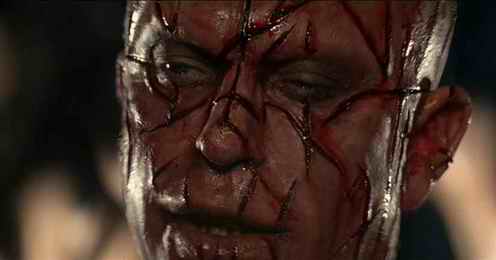
The Elephant Man


[This is a backdated entry to keep things alphabetical. Bought/written March 2012.]

Long before home video, I watched David Lynch's The Elephant Man on broadcast television — possibly even PBS — one Sunday afternoon. Like many films I watched as a child, this film was probably inappropriate viewing for me, but I sat there transfixed anyway.

As an adult, The Elephant Man works differently. My childhood curiosity and fascination with John Merrick's appearance have given way to analytical detachment. This time through, I'm finding myself more fascinated by the monstrous personalities in Merrick's world.

Anthony Hopkins plays a doctor named Frederick Treves, who finds John Merrick, "The Elephant Man" (played by John Hurt) in a carnival sideshow. Freddie Jones plays Bytes, Merrick's sadistic "owner," who beats Merrick and exploits him for profit. Treves, under the pretense of helping Merrick, takes him away from Bytes and out of the squalor and abuse.

But Treves isn't that much better than Bytes (a point Treves eventually sort of realizes). Almost immediately, Treves wheels a half-naked Merrick out for a lecture hall full of medical colleagues, and explains Merrick's physical condition using cringe-worthy terms such as "insidious," "perverted," and "lamentable."

As the coup de grace, Treves finishes his presentation by noting that Merrick's genitals are completely normal and unaffected. Not content to allow his audience to take him at his word, Treves has his assistants remove Merrick's final article of clothing, leaving Merrick to stand there, naked, before the hall. Fundamentally, Treves' capacity for humiliating Merrick is not that much different from Bytes'.

All of this is in the name of medicine, of helping Merrick, to see if he can be helped — or so Treves says. Yes, Treves gives Merrick a cleaner, more comfortable place to live, provides food, clothing, and medical care, and encourages Merrick to speak, but Treves also refers to Merrick as an "imbecile" and an "idiot" — words that are insults now, not clinical terms.

In a way, the film works as a kind of indictment of rich, white, liberal guilt. Treves wants to help Merrick, but he also sees Merrick as an opportunity to help himself. "All you do is prophet from another man's misery," Treves says, scolding Bytes for his treatment of Merrick (not realizing that profit is more than just monetary gain, or admitting his own ulterior motives).

One could make the case that Treves represents modern liberalism while Bytes represents modern conservative views. Treves wants to help — at any cost, mind you — but he also helps himself in the process. Bytes basically holds Merrick captive and sees monetary gain as a primary motivator — the feelings and fortunes of others be damned.

(Note: I realize this is an oversimplification of political viewpoints. It's just a blog, people. Chill.)

But hang on: if Treves represents liberal ideals and Bytes represents conservative ones, then what does Merrick represent, if anything? The masses? A powerless third party?

I wonder if it's a stretch to argue that John Merrick is a kind of ironic representation of a John Galt type — a character who just wants (or deserves) to realize his individual freedom and self-reliance, but falls victim to laissez-faire capitalism and the greed and foibles of the human collective. I can hear my libertarian friends now: "I'm a human being!"

Or, you know, maybe it's just a film about how exploitation of the less fortunate is wrong, and the simple moral stands: Everyone has the right to be treated with dignity and respect.

I found The Elephant Man on DVD last week. Now out of print on both Blu-Ray and DVD, I was fortunate to find a copy at all. Not that I go around looking for a copy of The Elephant Man, but when I saw the DVD at my local Half Price Books, I felt compelled to buy it so I could put some thoughts down here.

Definitely one of the most depressing and fascinating films I've ever seen, The Elephant Man might well be David Lynch's best film. Certainly, it's Lynch's most accessible film prior to The Straight Story (1999), and far from Lynch's more esoteric work (EraserheadLost HighwayBlue Velvet).

The Elephant Man isn't a film that I've pined to see or even own, but it is an important film — one that I've thought of often since my first viewing all those years ago, but never take time to re-watch — and one that makes a magnificent case for the humanity to be found within us.

Tuesday, August 10, 2010

The Electric Horseman


If you've never heard of The Electric Horseman, I won't be surprised.  I'd never heard of this film either before I took a Film Genres course at Ball State.

I never forgot this film after that.

The Electric Horseman is a Sydney Pollack film from 1979 that stars Robert Redford's mustache and chest hair, and Jane Fonda's hilarious clothing, sunglasses, and hairdo.  (I'll pause here so that all the Vietnam veterans in the audience can mutter, "Bitch.")

In that Film Genres course, my professor billed this as a populist film, which celebrates popular themes, pitting common people's values against the elite (and often crooked) rich/ruling class/management/whatever.  Here's a good list of examples.

Basically, populist films are about the underdog majority; we might be great in numbers, and we're definitely right, but for whatever reason, we are powerless — unless we find a way to rebel.

That's sort of what Sonny Steele, Redford's character, does here.  The opening montage gives us a look at Steele's rise as a rodeo star, and his ignominious fall to washed out, drunken sellout reduced to wearing a riding outfit covered in light bulbs and hocking "Ranch Breakfast" cereal.  Trust me, the get-up is striking.

But Steele isn't the only character who should be doing something else.  We also meet Rising Star, the ironically named (at the time of the story, anyway) race horse that now serves as some corporate behemoth's mascot.  His best days are behind him.  He was a champion.  Now he helps a huge corporation make huge amounts of money.

Steele eventually goes on the lam with Rising Star, who Steele says should be "out to stud" instead of prancing around, drugged up on tranquilizers and in pain.  I can't help but think that Steele is also talking about himself.

Fonda's character, a journalist named Hallie, goes after Steele with a camera and every intention of writing a great story.

"Mamas, don't let your babies grow up to be cowboys" is a frequent refrain.  I love the older film styles of the 1960s and 1970s, with that one hit song they play like 60 times in the film.  When you get a great song, you play the shit out of it.  That's a bygone film technique, but at one point Willie Nelson, Robert Redford, and some other guy break into an a cappella version over adult beverages.

(Oh, and Willie busts out no fewer than three great songs for that soundtrack, including a great cover of the Allman Brothers' "Midnight Rider," which is totally worth hearing.  Willie can act, too.)

Pollack peppers the film with great little moments, such as when Steele and Hallie stop by a stream for a bite to eat, and Steele laments on all the wonder of his country, his home.  He makes mention of how the whole country was once underwater, and if you dig around in the hardpack, you can find skeletons of the life that used to live there.  Hallie just smiles, enjoying that Steele even knows these things.  Of course, Steele says, this is his country.

Pollack gives the audience few reasons to side with the corporate bigwigs, all of whom show themselves to be clueless assholes who care about nothing except money and their own livelihoods.  They don't count the costs in terms of impact on the world or the people they serve.  They think they're doing the right thing.  They're not.

Sonny Steele, whose life has lost meaning as he pursues the Almighty Dollar, decides to do the right thing, and damn the cost.  He steals the horse.

What follows is kind of a long story, and I can't tell you everything.

At one point, though, Redford and Fonda walk the horse across the plain, purple mountains in the distance, and they sing "America, The Beautiful" with the slightest tinge of irony.  

You know, you just don't hear many patriotic songs about money.

Anyway, the story is stirring, albeit saccharine, yet I never forgot The Electric Horseman.  I got my mom a copy on VHS for Christmas in the late '90s.  I always associated country music and horses with my mom, and knowing her, I figured she'd love this movie.  We watched it together, and I was right.

I also associate this film with my grandma.  In 2003, Willie Nelson came to Muncie and played on campus.  I knew a few months out, and I thought it would be a great idea to take Mom and Grandma.

Well, Grandma died a month or so before the show.  I ended up going with Mom and the people we were dating at the time.  I really wish I could've taken Grandma too.

While I was grieving, I found myself prowling the iTunes Music Store every night, listening to previews of old country songs from the greats: Waylon, Merle, Johnny, and Willie, of course.  George Jones was a big hit.  I spent a lot of money I really didn't have on music I ordinarily wouldn't need, but I needed it then.  Sure, I could've stolen the music, but I wasn't thinking like that.  I just wanted some peace.  I could hear my grandmother's voice in my head, and she needed a soundtrack.

Once in a while, this film would pop into my head too.  I missed this film.  I missed how this film made me feel, and who this film made me think about when I watched.

Unfortunately, I couldn't find the film on DVD.  I searched and searched and no store had this one.  I didn't want another VHS copy.  Finally, I gave up; I bought a copy of the DVD on eBay when the title was out of print, which cost me quite a bit, and I didn't care — this one's a bargain at any price.  (How this film was ever out of print confounds me.)  I've watched this one two or three times since then.  The transfer, or the source, or whatever, looks terrible and sounds meh.  But this looks a lot better than VHS, and in widescreen, too.  Maybe someday there'll be a Blu-Ray.

I look past Jane Fonda's ridiculous looks.  I look past Robert Redford's cowboy thing.  I find the country music and popular themes comforting.  I look past the fact that this film is blatantly pandering to common people and their values, and in doing so made tons of money.  Watching this film is like eating at Cracker Barrel, the restaurant that commodified and perfected the food of the American working class.

This is what people want.

Well, I'm generalizing.  This is what I wanted after Grandma died, and when I fell out with Mom, and when I couldn't figure out Dad for the umpteenth time.  The Electric Horseman is my comfort food.

This is a good film for me when I can't make sense of my life and the choices I've made and the living I make, or when the things I can't control or change make me feel sort of helpless and the words don't come easily.  I can watch a film like this and disappear into the big, sweeping nothingness of America, the best parts, and go the way of Rising Star for a while.

I like to think this film can fix everything, if only for a couple of hours.

Sunday, August 8, 2010

Eastern Promises


I don't normally reach for David Cronenberg films.  Often dark and violent, his films require me to visit a specific frame of mind, and that's not always easy.

Actually, I have trouble going there most of the time.  I don't like walking away from a film feeling dead inside, and I seem to have labeled Eastern Promises as one of the films that leaves me devastated, even though I'm reminded tonight that such a label is inaccurate.  All things considered, Eastern Promises ends on an uplifting note, but if the film's content is any indication of what actually goes on in the world, and the kind of people who live out there, then I'm not sure I want to be reminded all that often, which makes me wonder why I even own the DVD at all.

I got a similar feeling after watching Stephen Frears' Dirty Pretty Things, his film about the black market human organ trade.  I love Stephen Frears' films, but I couldn't see myself watching Dirty Pretty Things again because I felt so devastated afterward.  I never picked up the film on DVD.  I probably won't watch the film again.

With Eastern Promises, though, I kept seeing the DVD in stores and I couldn't stop thinking about the film, most notably Viggo Mortensen's performance as the Russian mobster and Naomi Watts' underrated performance as Anna, the midwife who lost her own child.  I decided that I didn't feel quite the same with this one; despite the violence and shock, the story wouldn't let me go.  This is a solid piece of writing that ties up just enough, that shows just enough, that I want to go back from time to time.

Cronenberg's films often feature shocking violence and gore, but always seem to know where to put the line between "just enough" and "too much."  He does not shy away from graphic content, but his films are not just graphic for graphic's sake.  Though disquieting, I get the sense that every moment, every one of Cronenberg's choices, belongs in the film.

Supposedly, Cronenberg is making a sequel, with Viggo Mortensen returning to reprise his role as Nikolai.  I've seen several comments questioning why a sequel is necessary, and I don't understand why anybody would refuse such a thing.  Nikolai is a character worth reprising, and it's not like Naomi Watts took down the Russian mob.  There are stories left to tell, and I'm looking forward to seeing where Cronenberg and Mortensen go next.

Of course, I just might need to find the right frame of mind before I go.