Tuesday, August 31, 2010

F for Fake


Orson Welles' F for Fake is a wild, experimental film — not a narrative, kind of a documentary, yet more of an essay on fakery put to film in which the filmmaker fools you, too.

Here, Welles contemplates illusion, forgery, fraud, and other forms of deceit, focusing on the infamous art forger Elmyr de Hory, but also spending time on Clifford Irving, who gained notoriety after he wrote the fake autobiography of Howard Hughes (and went to prison for same).

Welles shows the connection between de Hory and Irving — they were friends, spending time on the island of Ibiza in the 1970s.  Irving even wrote Elmyr de Hory's biography.

So, once Howard Hughes got wind of the "autobiography," he was forced to come out of seclusion — sort of.  Hughes held a phone press conference with reporters in order to deny any involvement with the book and any connection to Irving — or did he?  Hughes himself was a faker, having hired body doubles of himself.  The recording of Hughes' voice sounds more like Woody Harrelson's impression of Larry Flynt.

They also interviewed Clifford Irving by phone.  But was that him on the phone?  What's up?  What's down?  Black?  White?  This film is astonishing, peeling away layer upon layer of trickery, flipping filmmaking on its ear in the process, and taking a place among Welles' most innovative and interesting works, and a masterpiece of editing.

Let's not forget, even Welles started out as a fake.  He spent a career spinning tales and playing roles in the grand illusion of theatre and film.  His Mercury Radio version of "The War of the Worlds" fooled people into thinking that Martians were invading.  Beautiful!

Welles does some wild stuff with perspective here.  He frequently goes from the camera's perspective to the editor's, moving back and forth from the footage and Welles looking at and commenting on the footage playing in front of him on a Steenbeck.  He cuts together a variety of film stocks, changes frame rates, drops in still photographs, freezes the film and provides direct-address monologues, and generally creates a disorienting viewing experience of asides, interviews, B-roll, and personal reflections.  This article provides a much more detailed explanation of what Welles was doing here.

I'm a big Welles fan; for me, Citizen Kane, Touch of Evil, and even Carol Reed's The Third Man are some of the finest films ever made.  F for Fake is not like any other film; Welles seems at his most comfortable here, though, often smiling and laughing along with the revelations of the film.  I went through a serious Orson Welles appreciation phase a few years ago, picking up this film and several others before giving up in my attempts to locate quality versions of his minor films.

Most of Welles' other films are either not available on DVD (The Magnificent Ambersons) or feature transfers so poor as to render them nearly unwatchable (The Stranger, The Lady from Shanghai, The Trial, Chimes at Midnight), which makes F for Fake even more rewarding — not only is this film on DVD, but one of two Criterion Collection releases (the other being The Complete Mr. Arkadin — a set that includes three versions of the same film).  Ironically enough, the two Criterion releases of Welles' work are easily obtainable yet stand as the most impenetrable works of his career.

Sadly, Welles almost always had trouble raising money for his projects.  In his later years, he bemoaned having to spend so much time trying to find funding instead of, you know, actually getting to create something.  He was known as a creative tyrant.  He was so direct, so demanding, so dissatisfied with the mediocrity of others, and to some, so arrogant, that he turned people off and/or turned them away.  People misinterpreted and resented his intensity.  People didn't understand him.  He wasn't good at schmoozing.  He wanted to create.  So many people didn't take him seriously, and in the end, Welles sort of brought that on himself.

Even though Welles, left to his own devices, could create the greatest films ever made, he was always fighting off studio meddling and trying to find money to fund his eccentric efforts.  When I imagine what Orson Welles could have accomplished in this age of digital cinema, nonlinear editing, and independent filmmaking on the cheap, I am overwhelmed at the possibilities.  He needed people to get out of the way and let him do his job.

Filmmaking isn't like that, though.  If Welles were solely a painter or solely a writer, he could have done anything he wanted, but because filmmaking is such a collaborative medium of experts, egos, sharks, and know-nothings, he languished for years trying to get project after project off the ground.  That's not to say that his own hubris didn't play a role in his failings — on the contrary, Welles' hubris is the stuff of legend, detailed in books and cinematic depictions — but he had some seriously terrible luck, too.  His story is by turns sad and triumphant, and I find the whole of his career absolutely fascinating.

By 1975 and F for Fake, Welles' film career was largely over.  Afterward, he resorted to schilling Paul Masson California wines and, in one of the cruelest ironies of his or any other career, playing a gigantic, planet-eating robot at his largest and unhealthiest — indeed, not long before he died.  He became a parody of himself, and then other people parodied him.  When you're larger than life, you're easy to hit.

According to Bogdanovich, Welles wanted to do more "essay documentaries," like this one, but he never got the chance.  F for Fake is Orson Welles' last completed film (he later finished a ho-hum television documentary called Filming Othello, which has never come to DVD).  F for Fake stands as a bizarre, multilayered meditation, and a fascinating postscript to an illustrious, puzzling career.

Monday, August 30, 2010

The Evil Dead/Evil Dead II


I toyed with how to do this entry.  I didn't really want to watch the Evil Dead films back-to-back.  So I decided to do something ridiculous instead.  I'm watching both of these films at the same time.

In front of me, I have The Evil Dead playing on the television, and to my left, Evil Dead II is playing on my wife's Macbook.  You should see this; I look like an idiot.

See, Sam Raimi's The Evil Dead and Evil Dead II are basically the same film — the second one just has more money and seems slicker.  I joked with my in-laws about writing an entry for the first film and then copying and pasting the same entry for the second film.

In the end, that seemed like too much of a cheat — but the two films are so distinctly connected, I have trouble thinking of them individually.

I've watched the films back-to-back before, but not since I had the films on glorious VHS about ten years ago, so I don't quite remember everything.

Basically, the plot is this, both times: Bruce Campbell takes a girl to a cabin in the woods, and while there, he manages to bring forth evil, and he has to fight it off.

Of course, there are plenty of differences.  In the first film, he goes with a group of people: three women and another man.  In the second, he just takes a date.  Researchers and hillbillies play a role in the second film, as does Ash's chainsaw for a hand.

Still, the two films are too similar to not have a clearer connection.  That has always bothered me.  There are a some throwaway lines that could've been rewritten to really connect the films, but as is, the two films don't connect as well as they could, so I feel like I'm kind of watching the same film twice or something.

The flaw is in using the same actor to play the same character who has basically the same experience in the cabin in the woods.  No real indication is made as to whether the Bruce Campbell character of the sequel remembers the events of the first film, and if I've missed those indications, I just have one question: Why would he go back there?  If your answer is, "Because he killed the evil in the first film," then sadly, you are wrong.  I have a better answer for you.

If you assume Bruce Campbell's character either went insane or repressed everything after the events of the first film (which isn't much of a leap), then Evil Dead II works quite well as a direct sequel.  There.  That's all you need to do.  Just believe he went nuts or forgot. Easy!

Side by side, I'm realizing how full of shit I kinda am, because the two films actually don't line up all that well.  If they were made from the same script, wouldn't the events of the first film happen at pretty much the same moments in the second film?  I started them at the same time.  At the 26:00 mark, trees are attacking Ash's friend in the first film.  At the 26:00 mark of the second film, Ash's hand just went bad.  The differences go on and on. Nothing much lines up at all.

That leads me to an important conclusion that all Evil Dead fans should consider: Raimi didn't just re-make the first film with more money.  He re-envisioned the first film, using a bigger budget, more imagination, more humor, more over-the-top violence and gore, and more Bruce Campbell, who can't remember the events of the first film because the trauma made him insane (or something).

Now that I've watched them simultaneously, I see them differently.  Groovy.

Sunday, August 29, 2010

Event Horizon


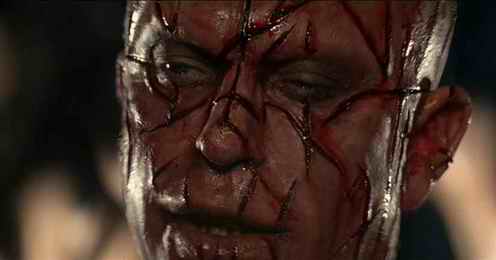
I missed Event Horizon in theaters in 1997, and ignored the film based on the reviews I'd seen, which pretty much savaged this film like Sam Neill on a Satan bender in space.  Spoiler alert?

About two years ago, I happened across the Amazon listing for the DVD.  I'm not sure how; I probably was surfing and clicking on Amazon recommendations or something.  I saw gobs of 4 and 5-star reviews.  I couldn't figure out where all these positive reviews came from because I only knew this film as a steaming turd.

But I was feeling adventurous, and in the mood for something messed up, maybe.  I decided to buy this one blind (ironic?), so away I went to Fry's Electronics while the wife was away on a trip, and a short time later, I was watching Event Horizon for the first time.

I can understand why people's opinions are so split.  The film is slow to start, with only some loud noises and a weird dream prior to the 24:00 mark, when actual people go inside the Event Horizon.  Madness ensues not long after that.  We get creepy lights, a floaty glove (or is that a hand?), and lots and lots of blood.  And we're only at the 28:00 mark now.  The obvious Alien parallels are here, along with the Hellraiser ones.  There's not much earth-shattering here in terms of plot.

Event Horizon deserves kudos for set design, makeup, and cutting-edge special effects (for 1997).  The premise is ludicrous, some of the acting comes up lame, and I get a little tired of the loud noises-as-scary moments in lieu of a plot.  But the film doesn't quite deserve all the ripping.

My father-in-law calls this film boring and slow, while my brother-in-law really enjoys this one, even if he admits Event Horizon is "messed up."  I'll admit the film could move a little faster, and could go even further into "messed up" territory, but then again, go much further and you might drive the audience mad.  What is seen cannot be unseen.

Judging from the split reviews, they might not be far off.  This film goes into some seriously dark territory.  (See what I did there?  Space?  Dark?  Anybody?  Hello?)  Although this one doesn't quite become a classic film, or even a classic B-movie, damn, Event Horizon sure tries.

I respect that.  That's why I keep this one.

European Vacation


"Kids!  Big Ben!  Parliament!"

National Lampoon's European Vacation is probably the Vacation film that I've seen the fewest times, and possibly the one I like the least.  I don't even own Vegas Vacation, so maybe this one juuust gets the edge for the few laughs I get.

Why do I own this one at all?  Because they packaged the first film with this one for less than $10 on DVD and I couldn't resist the deal in 2006.

European Vacation was the only window to Europe that I had as a kid.  My family was never going overseas.  We didn't have the money for that, and the economy was so shitty during the Reagan years that politicians and Hollywood films were touting the awesomeness of the U.S.A. so that people wouldn't think to go anywhere else.

At the time, I drank that Kool-Aid down.  I can remember Lee Greenwood's stupid "God Bless The U.S.A." song on the radio, and I can remember singing patriotic songs in school as if the ideals of The American Dream were a given.  I'm sure my dad really enjoyed all the patriotism — he had time to do so when he was laid off for 2 1/2 years as the manufacturing sector gasped for breath.

I didn't realize until much later that most Americans have a hilariously narrow view of the rest of the world, fueled by the ignorance in films like this one.  Every time Hollywood sets a film in Europe, they play to stereotypes so that ignorant people can follow along.

I didn't know any better when I was younger, but now films like this kinda piss me off.

Consider the incredibly negative depiction of Europe here (obviously played up for comedy).  You can't understand the English hotel clerk.  The Brits don't have bathrooms.  They're super nice, to the point of idiotic.  The French will curse at you if they realize you're an American.  Someone will steal your camera.  You'll get to Rome and get wrapped up in international intrigue.  You'll get back home and feel so glad to see the Statue of Liberty, your cares will just melt away.

Okay, maybe some of that's true.

Of course, to the film's credit, we do get an American family that does all the stupid American things when abroad.  They wear berets in France.  They buy ridiculous Italian clothing.  They get on a rotary near Big Ben and Parliament, and stay there.  They have no idea what they're doing, and it's funny because it's true.

So America doesn't get a free pass here.  When Americans go abroad, they do dumb shit.

Anyway, enough about that for now.

Ever wonder why the Griswald children change in every film?  Well, the easy answer is, some of them are dead.  Dana Hill, who plays Audrey Griswald here, fantasizes about overeating European foods at about the 16:00 mark.  In 1996, Hill died of a paralytic stroke brought on by years of difficulties with diabetes. Yikes.

Then there's the career of Jason Lively, who plays Rusty Griswald here.  The last film he did was in the early 1990s, and he's still living.  Not as bad as death by stroke, but still.

Paul McDowell, Ballard Berkeley, and Eric Idle play the three consecutive English motorists that Clark Griswald hits with the rental car.  American audiences know Eric Idle from Monty Python, but most Americans have never heard of the other two.  Turns out, both of them are pretty widely respected character actors in English television.  Berkeley played Major Gowen on "Fawlty Towers."  The film gets these things right.

There are positives to this movie.  You've just got to dig.

This is by far the dirtiest of the Vacation films, though, with a bare breast count in the dozens.  You get gunplay, robbers, chase sequences, and a chest beating anthem over the closing credits about how, like, totally awesomer America is compared to all those frou-frou-ey European countries.  The song is called "Back in America" by a band called Network, and for some reason the song is on iTunes.  I'm serious.

Shit like this is what convinces Americans that the rest of the world isn't just inferior, but that it doesn't matter, either.  That kind of nationalistic bullshit just pisses me off.  I'm glad I don't watch this film very often.  Bleh.

Eternal Sunshine of the Spotless Mind


Would you re-live your worst relationship even if you knew how things would work out?

Tough question. I'm not keen on re-living pain; once is enough. But what about the happy memories, the ones that are kind of fun to remember? What about your travels, your funny and awkward moments, the people you met? Most of all, what about everything you learned about yourself and other people?

In my closet, I have no fewer than three shoeboxes (I'd have to dig them all out to count for sure). Each shoebox contains a relationship. Inside each box, I have notes, photos, receipts, souvenirs, mementos, and outright junk imbued with meaning and memories from each girl who shared time with me. I keep stuff.

I know lots of people who wouldn't think of keeping stuff. They throw out every reminder when they break up with someone. For some, discarding everything of significance is part of healing, but for me that seems like cheating.

You learn to live with your baggage; you don't just forget you had any.

Those capable of the "emotional purge" might seem heartless, too. If we were never all that attached to someone, then throwing out the reminders isn't too difficult. For me, I can't bring myself to throw out something that, at one point, meant so much. Somewhere deep down, these things, this stuff, still has significance. I'm not saying I feel the same way I once did; I don't. I'm saying these things still matter even though everything has changed. I can't stop speaking in abstracts. I'm very sorry.

For me, some days, I miss those girls. I miss their positive qualities (I don't just mean their unique hotness, brainy-ness, whatever). I don't miss these people so much that I'm willing to wreck the life I have now, because now is best of all. I don't miss their flaws, their things that were impossible to live with or understand. I don't miss their Gordian knot logic. I don't miss who I was at the time.

But some days, I do miss talking to them. In most cases, I hope they're doing well. In a few rare cases, I'm still friends with them. We don't hang out much, but we get along fine now.

I know a few people, including one particular ex-girlfriend, who would never allow my shoeboxes in the house. "Isn't it weird to keep mementos from an ex — more than one ex? What does that say about your level of commitment to the present relationship?"

Nothing. No, really. Nothing.

What does the present have to do with the contents of a shoebox, tucked away in a closet, containing the detritus and effluvia of dead relationships? The present is not relevant, except that I had to live out the contents of each shoebox, each photo album, each of those old e-mails and letters, in order to find my way here. That's all.

I like keeping a map of how I got here, and I like looking at the map every now and then. I need to remember how long and how far I traveled. Most of the time, I don't need to see the breadcrumb trail. If I look once every couple of years, I'm fine. But I need to remember how I used to be in order to be how I am now. If a shoebox rarely opened really impacts a relationship that much, then you are in a shitty relationship and you need to find someone who understands you better.

"Why do I fall in love with every woman I see who shows me the least bit of attention?" Joel Barish asks. He's a glum introvert, awkward and lonely.

That was me. I had this crushing, painful fear of being alone for my entire life. I'd lie awake nights, wondering what the next girl would look like, or what her name would be, and how her voice would sound.

I'd meet a girl, maybe on a bus, maybe on a plane, maybe at work or in class, didn't matter, and she'd be polite to me but nothing more.

I'd take that as so much more.

I'd go home, obsessing about her, whoever, and sometimes I'd even get a number and go home and immediately call her. Or I'd go out of my way to see her again. I'd ride the bus again, or walk down the same hallway at the same time.

Every single time I did this, I'd never see the girl again.

I had pipe dreams of missing out on "The One." I'd get depressed. I missed my chance. I missed everything. I made everybody around me miserable. Some days, daylight to dark and beyond, I was thinking about the same girl. Waste of time.

Sometimes, I'd meet a girl differently. She'd sit down next to me in a class and stay there the whole time. She'd work with me, and I'd see her all the time. We'd meet at a party and talk for hours. Something would click. We'd go out, sparks would fly, and next thing I knew, I was in a relationship. And the next thing I knew, the relationship was in a shoebox.

"Technically speaking, the procedure is brain damage," Dr. Howard Mierzwiak says.

I don't need the brain damage. I don't want to forget my ex-girlfriends. I'm thankful for every single one — those who got away, those whose hearts I broke, and those who were just psychotic, baby-crazy harpies who wanted to eat my soul. All they did was save me.

"Those who cannot remember the past are condemned to repeat it," wrote George Santayana in 1905. Charlie Kaufman's characters don't seem to mind, but I'd hate to forget.