Tuesday, July 27, 2010

Eagle vs. Shark


"My mom got kicked in the head by a cow.  I can't go near cows now because I think about her too much."

Such is the kind of dialogue you get in Eagle vs. Shark.  Here's a choice exchange between brother and sister:

"Stop calling me 'cockhole,' bitch."
"Cockhole."
"Grr!  You're a bitch, and you're gonna die of diabetes."

I mean, come on.

Eagle vs. Shark is a terribly underrated and unknown quirkfest of an independent film from New Zealand, directed by Taika Waititi.  The protagonist, Lily, is a fast food clerk who has a crush on Jarrod, a video game store clerk (Jemaine Clement from "Flight of the Conchords").  In short, they get together, and Jarrod invites Lily to visit his hometown, so that he can fight his high school nemesis, Eric.  When they arrive, Lily meets Jarrod's family.  Quirkiness with real emotional depth ensues.  You even get whimsical stop-motion animated interludes featuring apples.

As much as I hate the comparison, this is sort of like Napoleon Dynamite, but more heartfelt, and more New Zealand-y.  I really don't want to reveal many more specifics about the story of Eagle vs. Shark.  You're either in the camp who can take a quirky indie film or you're not.

But I will say that Jarrod wears pants that say "Awesome" down the leg.  He also has a mullet. If that does anything for you, like if you want to rent a movie and find yourself in a mood to watch a man with a mullet wearing pants that say "Awesome" down the leg, then I would suggest Eagle vs. Shark.

Unfortunately, films like Eagle vs. Shark, Napoleon Dynamite, and to some degree, Juno, all get lumped together under the umbrella of precious and condescending (and sociopathic, misanthropic, and downright eeeevil) indie comedies, a categorization that I reject.  Those critics miss the point.

Here's a screed on Napoleon Dynamite and Eagle vs. Shark, written by someone who openly admits to not watching all of the latter.  Obviously he wasn't engaged with the subject matter, which is fine, but he makes some pretty damning accusations about a film he didn't finish.

Eagle vs. Shark is sort of like a Todd Solondz film, but infused with actual joy and humor, and doesn't leave me feeling empty and hopeless, like my heart has been squeezed and my confidence in the goodness of humanity has fallen away.  If you want to understand why we have school shootings and why little girls and boys grow up to be horrible people who tell homeless people to get jobs and think Sarah Palin is just neat, then watch a Todd Solondz film.  I'm not saying his work is bad, but you'll want antidepressants afterward.

Eagle vs. Shark does the opposite.  Despite taking me to dark places and offering awkward, hide-behind-the-couch humor (my wife's phrase), the film ends on a note so uplifting, I really don't want to hear the cynics bitch.  (Also, any movie that features The Stone Roses' "This Is The One" under the climactic sequence sells me right there.)

It's not that films like Napoleon Dynamite and Eagle vs. Shark have no heart, or that the directors hate their characters, but you'll hear plenty of critics say that.  It's that these characters have so much heart that the directors have trouble getting all of it on the screen.  (I know that sounds sentimental, and I don't care.)  Waititi's characters harbor deep longing, unfulfilled dreams, and repressed emotional traumas, and they keep going despite their pain, and fuck if they don't find joy in their lives anyway, with quirks as their defense mechanisms against the world and all the bullshit that life has dealt them.  These are characters who get up, every day, no matter how much it hurts, and they do stupid, insane things to themselves and other people, and they instantly regret what they've done, and they stumble onward.

To dismiss this film is to not understand; these characters are not empty — they're too full, and what spills over is what they can't contain. There is something rare and beautiful here, and because I identify with these kinds of characters, I find myself laughing not at them, but at the pieces of myself that I see in them.

Monday, July 26, 2010

Drunken Angel


Drunken Angel is Akira Kurosawa's first film with longtime collaborator Toshiro Mifune, the legendary Japanese actor who appeared in 16 of Kurosawa's films between 1948 and 1965, along with another 160-plus films in his long career. 

Here, Mifune plays a gangster who has taken over some territory in postwar Tokyo while the real boss, Okada, is away in prison.  Mifune's character is all bravado; he suffers from tuberculosis, one of myriad diseases to strike postwar Japan.  Kurosawa's tackling the issues of the time is a brave move that elevates this picture from your standard noir exercise to film art, and for these reasons, the film is widely considered Kurosawa's breakthrough piece.

But Mifune is not alone here; his opposite number is a bristly doctor played by Takashi Shimura, who Kurosawa cast in more than 20 films from 1943 to 1980 (yes, I'm looking at the same Wikipedia entry as you; I'm not writing a master's thesis here).  Although the Kurosawa-Mifune collaboration is a bit more widely known, Kurosawa's collaboration with Shimura started earlier and ended later, resulting in more finished films and a much richer legacy.

All trivia aside, what really works for me in Drunken Angel is the writing — at once embedded in the context of postwar Tokyo and presenting characters still relevant in the present day.  Kurosawa and co-writer Keinosuke Uekusa based Mifune's character loosely on a gangster Uekusa knew personally, but the two writers struggled with Shimura's character, fighting to keep the doctor interesting and fully formed rather than a wooden do-gooder whose altruism would bore audiences and ring false.  Only when Uekusa and Kurosawa remembered an alcoholic doctor they both knew in Yokohama did they find the inspiration for Shimura's character here.  They needed a character with flaws rather than someone who exuded plain goodness.

That kind of character development and contrast is essential for storytellers. Yet every day, hundreds of scripts float around Hollywood with exactly this problem.

Kurosawa's films always seem informed by his life experiences, but not so much that his stories were overwhelmed.  Here, he clearly bases his two leads on real people from his life, and in doing so creates two of his strongest characters, possibly the strongest characters he'd created at this point in his career.

I often feel uncreative when I base characters and/or events in my scripts and short stories on real people and experiences. Anybody can write down something that actually happened, right? The real writer is the one who can create from nothingness, right? I then have to remind myself that there is no such thing as "writing from nothingness."

Writing doesn't happen in a vacuum. We write from somewhere; good writers just have the strength of articulation. We don't choose the events, but we do choose the words. Throughout Kurosawa's career, he used real people and experiences as fodder for his work; there's nothing wrong with this. Sometimes these things are truer. But we can't forget the drama and the structure, too.

At about the 45-minute mark, Kurosawa turns to the guitar player who has been plunking away at the same song in the streets at night. Out of the shadows steps an older man who asks to see the guitar. He takes a seat and plays a more complicated tune (well, he mimes playing — the sync is off and so are the placements of his fingers). This is Okada, the boss that Mifune's character has replaced. Just as Mifune's and Shimura's characters have buried the hatchet, a bigger fish arrives (unbeknownst to them) to raise the stakes. That's good writing.

Drunken Angel tackles some issues that you just didn't hear much about in postwar American film.  Although the Japanese couldn't depict the occupying military force at the time (along with several other prickly censorship regulations), in America, you'd be hard-pressed to find a mainstream film from the same time period that openly discusses syphilis and uses profanity.  Drunken Angel does that, and along with depicting characters closely resembling people, places, and a time the writers knew, seems all the more real for doing so.

Sunday, July 25, 2010

Akira Kurosawa's Dreams


I'm usually not interested in other people's dreams.  The conversation usually starts like this:  "I had the strangest dream."  Then the person insists on telling me a story made mostly of nonsense, and when the story (mercifully) ends, the conversation usually ends like this: "Isn't that weird?"  That is sometimes followed with: "What do you think that means?"  Example:

"I had the strangest dream.  I was in the grocery store, and they didn't have any milk, so I asked if they had some in the back and they invited me to the back room to check with them.  I went along and found gallons and gallons of milk, but they were all sitting outside the cooler, and a giant spider was guarding them.  I said, 'What about this milk?' and the clerks all laughed at me.  Then the spider started chasing me, but it wasn't a spider anymore; it was a crab.  I ran for a while until one of the clerks hollered at me to start running sideways and the crab couldn't get me.  But then the crab got me and when I turned, the crab was my second grade teacher, and then I woke up.  Isn't that weird?  What do you think that means?"

Uh, yeah, that's pretty weird, but also frustrating to hear.  I'm used to stories with your typical beginning-middle-end structure, so when I hear a story with a beginning of sorts and a middle or something like a middle, and an ending that is always the same ("Then I woke up.") my instincts as an interpreter of stories is to try and organize the information.  I get frustrated easily when stories don't make any sense, when details are introduced with no payoff or clear direction, and when suddenly, the elements of story that we typically consider anchor points — identities of characters, locations of stories, objects for the dreamer to accomplish — can change without warning or logic.  This is the nature of dreams, not the nature of storytelling.

In short, when a person recounts a dream to me, that person is annoying me.

This is through no fault of his/her own.  I just want to hear a story that makes sense, and I can't expect a dream to do that, nor can I expect the rest of the world to dream in effective three-act story structure.  But in a way, I do expect that.  I'm not saying I'm right; I'm just saying.  I can't tell you everything.  All I know is that I hate hearing people talk about their dreams.

So when presented with Akira Kurosawa's Dreams, I run the risk of extreme frustration and fatigue.  Here's a two-hour film in which Kurosawa essentially makes film adaptations of his own dreams, with the exception of one vignette, "The Tunnel," which Ishiro Honda directs here.  Dreams is a series of eight vignettes, each with a male protagonist, presumably Kurosawa himself.  In each vignette, the protagonist is at a different age and experiences different realms — a forest in summer, a spring full of cherry blossoms, a windswept, snowy mountainside, and so on.  The adventures starkly contrast with each other.

Oddly, I don't find myself frustrated at all.  Perhaps this is a question of timing.  I tend to watch slower films on Sunday afternoons, when the rest of the world is slow, too (in my head).  Kurosawa was such a visionary, he dreamt in stories.  Each dream, despite fantastic elements, spins coherent stories anyway.

Like "Crows," the one about the painter who, when wandering the Van Gogh museum, steps into a painting and finds himself talking to Van Gogh, played by Martin Scorsese.  This Van Gogh is a brusque New Yorker Dutch painter.  They talk about drive, cutting off an ear, and how little time there is left to paint.  Then Van Gogh is gone, leaving the aspiring painter to wander Van Gogh's paintings in a search for the master.  He eventually finds Van Gogh, walking in the distance, and then the dream is over.  The painter never catches up to him.  Pretty silly sounding, but highly effective on screen.

Dreams is an enigma is Kurosawa's body of work, but at this late stage of his career, he obviously felt free to do what he wanted, and here he uses his dreams to ruminate on themes such as the futility of war, mankind's potential to destroy the world, and the pursuit of art in a world in which the artist has little or no control.  I'm combining his themes a bit here, but that's what I take away from this film.  His latter-day works are often derided, but even Kurosawa's weak films are still better than most films released around the same time.

I teach a class in which I give an assignment that requires students to choose from my school library's holdings on DVD and write about them.  Dreams is the only Kurosawa film we have at present, but this is a perfect film for a visual arts school.  Naturally, I'd love if the library had all of Kurosawa's films, as well as another 1,000 DVDs, but I'm content with what we have for now, and with building my own library at home and keeping Kurosawa's entire oeuvre on hand for my own use.  In August, Criterion will release Kurosawa's first four films in an Eclipse set.  I'm all over that.

Kurosawa turned 80 the year this film was released.  He lived another 8 years and made two more films, wrote a few more, and a final film, a documentary on Noh theatre, is rumored to be released in 2010.  Kurosawa would be 100 years old this year, and organizations around the world are holding screenings and celebrating his life and work.  Even his minor films are great.

Bram Stoker's Dracula


[Note: In the commentary for Bram Stoker's Dracula, Francis Ford Coppola says when he adapts a work, he typically puts the name of the original author in the title, a la Mario Puzo's The Godfather.   Among fans, these works are customarily referred to by their original titles, sans author.  By that rationale, Bram Stoker's Dracula goes under "D" here.]

I've always liked Coppola's version of Dracula, despite his style-over-substance approach and screenwriter James V. Hart's tweaking of the original story and rather anticlimactic ending (after the sun sets, Dracula explodes out of the crate that carries him, and then somebody just runs up and stabs him, taking all the fight out, and he lives a little while longer flopping around in agony...meh).  While I've enjoyed this film several times over the years, I've never considered Coppola's version a "definitive" adaptation of Stoker's novel.  Instead, this is just another interpretation — one that explores Dracula as a tragic figure rather than just a plain old bloodsucker.

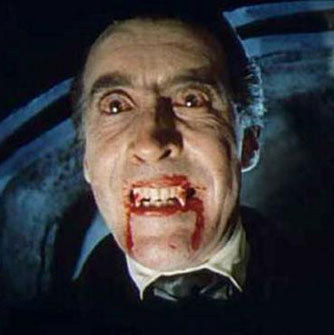
Of all the actors who have played Count Dracula over the years — Max Schreck, Bela Lugosi, Christopher Lee, Jack Palance, Frank Langella, Klaus Kinski, etc. — Gary Oldman is among the more memorable, but I think that's a generational thing.  I wonder how this film will last.  I've never heard anyone say Oldman is his/her favorite Dracula.  He's not mine, by any means.  The Dracula that I know and love is Christopher Lee.

Lee was Dracula several times in the Hammer Studios interpretations, which appeared on late night television when I was young.  I'd stay up late with Dad and catch Sammy Terry, Indiana's late night horror movie host, and if we were lucky, we'd catch Christopher Lee.  Thanks to Sammy Terry's show and my dad's negligence/coolness, I saw dozens of horror movies while growing up, including many of those Hammer films.  I was probably too young, because in those days I braved my way through dozens of nightmares, and to this day I'm not all that comfortable typing at a computer in a quiet house in the middle of the night.  I'm a bit jumpy.

(In the interest of full disclosure, my efforts to watch horror films did not always pay off.  I also caught Invasion of the Bee Girls and Empire of the Ants while staying up late.  I can remember Dad getting up in the middle of dozens of movies and leaving me with the remote control to soldier through such cinema shitpiles as The Swarm.  Hey, they can't all be winners.)

So when I think of Dracula, I think of Christopher Lee rather than Gary Oldman, but I can't forget Oldman's portrayal.  Then again, that might be because I can't watch this film without thinking of C. Montgomery Burns:


I couldn't help but borrow that image from this article, which is a dynamite read, by the way.

I once saw David Letterman interview Gary Oldman on "The Late Show."  Oldman was detached, uninterested, and barely answered Letterman's questions.  The interview was an awkward failure.  I forget the film Oldman was promoting (maybe this one?), but I've never seen Gary Oldman in the same light.  So when I see Oldman in this, or The Fifth Element, Leon: The Professional, Batman Begins, or any of the myriad films one can list, I can't help but remember that interview.  He's a solid actor who disappears into his roles and often is quite frightening as a villain.  I get the feeling there's not much inside him, though, sort of like how Peter Sellers has been characterized as a kind of shell for characters to inhabit rather than a self-actualized person who portrays others.  Then again, maybe Oldman is one of those actors who doesn't have time for the Hollywood hype machine, and would rather be working than doing some late night promotional interview.

Anthony Hopkins as Van Helsing is an inspired choice.  I love how he speaks so off-handedly about how he needs to cut off Lucy's head and then cut out her heart.  Even Coppola seems in on the joke, and they come back to that a couple of times.  Cary Elwes' horrified face is priceless.  Did I mention Winona Ryder is in this film?  I admire her work.

For most of the film, the 5.1 mix seems pretty ho-hum.  However, at 1:27, right as Lucy vomits blood on Van Helsing, a kind of unearthly clatter swings from the front channels to the right rear channel, and even though I don't consider this film all that scary, that moment freaks my shit out (technical term), especially when I'm trying to type, the house is mostly dark, and I'm not exactly paying attention to that part of the film.

What's with all the voice-overs?  Dracula, Van Helsing, Mina Harker, and Jonathan Harker all provide first-person narration at some point or another, either reading a letter to the audience or speaking journal entries.  Everyone kept a journal in the late 1800s, apparently.

And what's with the match-cuts?  I love a good match-cut as much as the next guy, but this film seems to have one in every scene.

Vampires are written to undeath, yet audiences keep going back.  For me, Coppola's film isn't exactly a masterpiece, but works as one great director's interpretation in a world where everyone else seems to have one.  

Friday, July 23, 2010

Donnie Darko: The Director's Cut


Richard Kelly's director's cut of Donnie Darko attempts to explain more about what this movie means, but tonight I caught myself wondering...is that necessary?

I sort of understood the first time.  I liked that Kelly's theatrical cut left enough unsaid and allowed the audience to fill in gaps and interpret what we want.  I typically like when writers and directors do that.  I don't need all the answers.

Then again, I've never seen the director's cut before tonight, despite owning a copy of both versions on DVD for more than a year.  Looking at the IMDB guide to the changes between the theatrical and director's cuts, we mostly get extended scenes and minor cuts that add up to quite a different film altogether. 

Regardless of version, there's really no reason (on paper, anyway) for this film to work.  Consider this futile and feeble attempt at a logline: A troubled teenager is awakened in the middle of the night, and he walks out of the house (grabbing a felt-tipped marker on the way?).  Once outside, he is met by a demonic rabbit who tells the teen that in 28 days, 6 hours, 42 minutes, 12 seconds, the world ends.  Uh...what?

Still, I love the sequence when Donnie arrives at school.  His feet hit the pavement as he jumps out the back exit of the bus, we get a nice lens flare, and Tears for Fears' "Head Over Heels" leads us to this great, long take, introducing characters in the hall: the bully, the uptight but clueless teacher, the love interest, the bully again.  (I love this song.  Not the only Tears for Fears song in the film, either: "Mad World" is covered under the closing montage, and one easily can draw connections between the themes of Jim Cunningham's hack self-help videos and the name of that band, as well as several of their songs not featured in the film, but all over the airwaves in the '80s: "Sowing the Seeds of Love," "Shout," "Everybody Wants To Rule the World," and so on.  I love this cast, too.  God, I forgot Patrick Swayze was in this, and I forgot he was dead.  Noah Wyle and Drew Barrymore: The man my wife would ditch me for in a second, and the woman with whom I'd return the favor.  I digress.  Let's get to the meaty contemplation here.)

Consider the theme of the Graham Greene short story, "The Destructors," which is discussed in Donnie's English class.  Donnie theorizes that the reason why the children burn the money is that "destruction is a form of creation, so the fact that they burn the money is ironic.  They just want to see what happens when they tear the world apart.  They want to change things."  Later, Donnie confesses to Gretchen that he was once in jail for burning down an abandoned house. 

Compare that to this exchange between Bruce Wayne and Alfred Pennyworth when discussing The Joker in The Dark Knight:

Alfred: A long time ago, I was in Burma, my friends and I were working for the local government. They were trying to buy the loyalty of tribal leaders by bribing them with precious stones. But their caravans were being raided in a forest north of Rangoon by a bandit. So we went looking for the stones. But in six months, we never found anyone who traded with him. One day I saw a child playing with a ruby the size of a tangerine. The bandit had been throwing them away.

Bruce Wayne: Then why steal them?

Alfred: Because he thought it was good sport. Because some men aren't looking for anything logical, like money. They can't be bought, bullied, reasoned or negotiated with. Some men just want to watch the world burn.

Then, if you want, compare The Joker's handwriting to that of Donnie's graffiti painted on the sidewalk under the bronze dog.  (Oh, come on.  The school compares everybody else's handwriting to the graffiti.  I'm just taking another step.)  Not a perfect match, and I'm sure readers with more experience with typography can see glaring differences, but consider the scrawling, unaware of boundaries or lines, and how that might convey a loss of balance or structure in the writer.

The supposed nihilism continues.  Donnie calls self-help guru and closeted pederast Jim Cunningham "The Antichrist" to his face in front of the school.  Eventually, Frank the demonic rabbit tells Donnie to "burn it to the ground," so Donnie destroys Cunningham's house by fire.

Does Donnie's nihilism come from "just being a teenager" or from his association with Frank the rabbit?  Well, now, let's not forget that his parents aren't exactly shining examples of caring.  He comes from a conservative household more concerned with indoctrinating their children than teaching them about right and wrong.  His father stifles laughter when he hears what Donnie said to his gym teacher, and his mom is repeatedly confronted with questions of her fitness as a mother.  Donnie's father advises him to use the f-bomb on people.  Donnie's gym teacher questions his mother's "commitment to Sparkle Motion."

About what, exactly, do Donnie's parents care?

Hollywood seems to associate nihilism with madness, when really, what is seen as nihilism might be an arrested state of existential crisis instead, or just the influence of bad parenting.  While lamenting the existence of Smurfs while shooting bottles and drinking with friends, Donnie ponders the point of living.  Is this nihilism after all?  "The search for God is absurd if everyone dies alone," he says at one point in the film.

Donnie tells his English teacher about Frank, a 6-foot-tall bunny rabbit, which makes his classmates giggle.  Let's not forget: This isn't the first time we've met a protagonist who can see a rabbit.  In Harvey, the protagonist sees a mostly harmless rabbit.  In Donnie Darko, the rabbit is the harbinger of the end of the world.  Oh, and then, because rabbits don't play enough of a role, what is the Graham Greene book replaced with on the school curriculum?  Watership Down — a book about a rabbit who can foresee the destruction of his warren and convinces his friends to get away from imminent danger.

[Forced Inclusion: I also have a pet rabbit, adopted from the Indiana House Rabbit Society (see link at right).  Rabbits, rabbits everywhere, like in that episode of "Father Ted."]

Perhaps the great irony of Donnie Darko is that despite all the evidence to the contrary, Donnie really isn't a nihilist and he doesn't want to watch the world burn; in the end, he wants to put things right and save everyone except himself.  He's a savior figure, not a madman.  He brings balance by sacrificing himself.  A nihilist wouldn't do that.

The tough part about this film is that there are so many interpretations.  This is just one, given a smattering of references and what they mean.  Maybe I'm hung up on this bizarre combination of trivia and semiotics.  Maybe my interpretation doesn't hold water.  Like a lot of stories set to film or written in books, upon revisitation I see a bit more, understand a bit more, question a bit more, and find the whole experience rewarding for different reasons each time.  Also, just so we're clear, there's no way in hell I could ever write a film like this.  Richard Kelly's stuff is beyond me.  I don't walk away with the desire to write my own story.  I just walk away with a tweaked perspective, and I enjoy that almost as much.

Ultimately, I'm glad both versions of Donnie Darko exist.  They work as companion pieces; the original cut is the definitive, while the director's cut is a kind of "alternate universe" version, which makes total sense for a film set mostly on an alternate timeline.